Quick Answer: Chihuahuas are a toy breed with very specific mobility risks, and the big one is medial patellar luxation. RVC VetCompass research found patellar luxation recorded in 4.0 per cent of UK Chihuahuas, and a separate primary-care study put the breed's odds at 5.9 times those of crossbreeds. Weight control, a harness instead of a collar, and keeping your dog off high furniture matter more than any supplement. For daily joint support alongside that, Pure Collagen suits a healthy Chihuahua and Mobility & Joints suits one already showing stiffness. At Chihuahua weights both are a 1 teaspoon (3g) daily serving. Any skipping, limping or coughing goes to your vet first.
Your Chihuahua is trotting across the kitchen. One back leg lifts, they hop for a stride or two, then they carry on as if nothing happened.
No yelp. No limp afterwards. You almost missed it.
Then it happens again a week later. And you start paying attention.
That skip is the single most recognisable sign in this breed. It is worth knowing what sits behind it, because a Chihuahua's joints do not work like a Labrador's, and most joint advice online is written for dogs ten times their size.
Why a Chihuahua's Body Is a Different Problem
The Kennel Club breed standard puts the Chihuahua at up to 2.7kg, with 1.8kg to 2.7kg preferred. PDSA gives the same range and a height of 12cm to 20cm.
That is an entire dog built at roughly the weight of a bag of sugar.
At that scale, everything is small. The groove the kneecap sits in. The cartilage rings holding the windpipe open. The bones in the forelimb. The jaw carrying a full set of adult teeth.
None of that means your Chihuahua is fragile in temperament. Anyone who owns one knows the opposite. It means the margin for error is narrow, and the things that protect them are mostly environmental, not medicinal.
Medial Patellar Luxation: The Defining Orthopaedic Issue
This is the one. If your Chihuahua has a joint problem, statistically this is the most likely candidate.
The kneecap sits in a groove at the end of the thighbone and slides up and down as the leg bends. In medial patellar luxation the kneecap slips out of that groove towards the inside of the leg, then usually pops back in on its own. PDSA describes the result plainly: it "stops the knee from bending, causes a limp and rubs past the bone".
The numbers put the breed risk in context. O'Neill and colleagues at the RVC, studying 5,660 Chihuahuas under UK primary veterinary care in 2016, recorded patellar luxation in 4.0 per cent of them. An earlier RVC study of 210,824 dogs across 119 English practices found patellar luxation in 1.30 per cent of dogs overall, but 4.9 per cent of Chihuahuas, giving the breed 5.9 times the odds of a crossbreed. Only the Pomeranian ranked higher.
Today's Veterinary Practice reports that medial luxation specifically runs around 12 times higher in small-breed than large-breed dogs.
Why toy breeds get it. It is not simply that they are light. Cornell's Riney Canine Health Center points to anatomy: affected dogs typically have "a more shallow femoral groove or a general malalignment of the limb involving the femur, tibia or hip". The American College of Veterinary Surgeons lists the same predisposing factors, including shallow femoral grooves, abnormal hip conformation and tibial deviation.
In other words, the quadriceps mechanism does not track straight over the knee. Genetics drive most of it, and it is frequently present from puppyhood.
What it looks like. ACVS describes the classic presentation: dogs "suddenly carry the limb up for a few steps ('skip'), and may be seen shaking or extending the leg prior to regaining its full use". That is the kitchen-floor hop.
You might also see your Chihuahua sitting with one back leg stuck out sideways, or running with the hind legs turned slightly inward.
Why it matters long term. ACVS notes that as the kneecap dislocates more often it erodes cartilage, "eventually exposing areas of bone which leads to arthritis and associated pain". Cornell adds that patellar luxation also predisposes dogs to cranial cruciate ligament rupture.
So the skip is not the whole story. The joint wear that follows it over years is.
The Grades, in Plain English
Your vet will grade the luxation. PDSA sets it out like this.
Grade 1: the kneecap stays in place while your dog moves. A vet can push it out during an examination, and it returns immediately when released.
Grade 2: the kneecap occasionally dislocates when your dog moves around, but usually goes back by itself.
Grades 3 and 4: the kneecap is permanently dislocated. At grade 3 it slips straight back out if repositioned. At grade 4 it cannot be repositioned at all.
The RVC epidemiology study found a median age at diagnosis of 4.0 years across all breeds, with a range running from 0.2 years to 19.0 years. Many dogs are picked up young, often during a routine check before the owner has noticed anything.
Grading is a veterinary job. Do not attempt to push your dog's kneecap around at home.
Tracheal Collapse, and Why the Lead You Use Matters
This one is not a joint problem, but it changes how you walk your dog, so it belongs here.
The windpipe is held open by rings of cartilage. In tracheal collapse those rings weaken and flatten, and the airway narrows. ACVS lists Chihuahuas among the small breeds most commonly affected, alongside Yorkshire Terriers, Pomeranians and Poodles. PDSA names it as a breed concern too.
The signature sign is a harsh, dry cough that ACVS describes as sounding "like a goose honking". Coughing when the dog is picked up, or when the collar is pulled, is another flag.
Here is the practical bit. ACVS advises owners to use "a body harness (not a neck lead or leash)". Cornell says the same, recommending "switching from neck collars to harnesses". Both also list weight reduction as a core part of management, and both warn about smoke and other airway irritants.
If your Chihuahua walks on a collar, change it. A harness spreads lead pressure across the chest instead of loading the front of the neck. It costs about fifteen quid and takes five minutes.
Cornell is honest that there is currently no cure, though medical management helps. Any persistent cough is a vet appointment, not a wait-and-see.
Small Bones Break Easily
Chihuahua owners get told this constantly, and the underlying reason is worth understanding.
West Midlands Referrals notes that radius and ulna fractures in small-breed dogs "often occur in young animals that have jumped off furniture rather than having been hit by cars", and that these fractures have "acquired a reputation for being at increased risk of non-union". The size of the bones also makes it harder to achieve robust surgical fixation.
Translation: a jump off the sofa is a genuine injury risk in this breed, and the resulting break can be difficult to heal.
The RVC Chihuahua study adds context on trauma generally. Traumatic injury accounted for 13.8 per cent of recorded deaths in the breed, ranking third behind heart disease at 18.8 per cent and lower respiratory tract disorders at 16.3 per cent.
What to do about it is not complicated:
- Put steps or a ramp against the sofa and the bed.
- Teach the dog to wait to be lifted rather than launching themselves down.
- Support the chest and hindquarters properly when carrying, and never let a child carry them unsupervised.
- Watch your feet. Being trodden on or sat on is a real hazard for a 2kg dog.
PDSA also lists Legg-Perthes disease in the breed, where the hip joint "dies and crumbles". Any sudden hind-limb lameness in a young Chihuahua deserves a same-week vet visit rather than a fortnight of watching.
Teeth and Jaws: The Problem Owners Underestimate
Dental disease is not a joint issue, but in this breed it is the most common health problem full stop, and a dog in mouth pain stops eating properly and stops moving normally.
The RVC VetCompass study found periodontal disease in 13.5 per cent of Chihuahuas, the single most common recorded condition. Grouped dental disease came in at 19.0 per cent. Retained deciduous teeth, meaning baby teeth that never fell out, affected 5.7 per cent.
PDSA attributes this to jaw shape, which causes tooth overcrowding and retention. The Kennel Club's Breed Watch entry for the Chihuahua flags "incorrect bite, incorrect dentition, retained puppy teeth, misplaced or missing teeth" and "wry jaw" as specific points of concern for judges.
The RVC authors were direct about it: dental disease and retained baby teeth "should be recognised as important health concerns for Chihuahuas, with preventative care for dental disease a key topic for discussion between vets and owners".
Brush the teeth. Ask your vet to check the mouth at every appointment. A Chihuahua who has gone quiet and stopped playing may have a sore mouth rather than a sore knee.
The Molera and Hydrocephalus
Owners ask about this constantly, so here is what the evidence actually says.
Many Chihuahuas have a soft spot on top of the skull, called a molera or persistent fontanelle, where the skull bones have not fully closed. Kiviranta and colleagues, publishing in the Journal of Veterinary Internal Medicine in 2021, imaged 50 Chihuahuas and found that 46 of them, 92 per cent, had one or several persistent fontanelles. The mean was 2.8 per dog.
So it is extremely common in the breed. Common is not the same as harmless, though. In the same study, dogs showing signs consistent with Chiari-like malformation and syringomyelia had a significantly greater number of affected cranial sutures and a significantly larger total fontanelle area.
Separately, PDSA lists hydrocephalus, "a build-up of fluid around the brain", as a breed concern, along with Chiari malformation and syringomyelia.
Practically: a molera on its own is not a diagnosis and not something to panic about. Protect the head from knocks. If you see circling, a domed skull, unusual head pressing, seizures, persistent scratching at the neck or head, or sudden behaviour changes, that is a vet visit. Nobody should be diagnosing a Chihuahua's skull from a blog post, including this one.
Weight: The Maths Is Brutal on a 2kg Dog
PDSA reports that nearly half of dogs in the UK are overweight. In Chihuahuas specifically, the RVC study recorded obesity in 5.9 per cent, the second most common condition after periodontal disease.
Now do the arithmetic. If your Chihuahua's ideal weight is 2.5kg, then 250g of extra weight is ten per cent of their body mass. On a 30kg Labrador the same proportion would be 3kg.
Nobody notices 250g. That is roughly a handful of training treats a day for a few weeks. On a dog this size it is a meaningful load on a knee that already has a shallow groove.
Canine Arthritis Management explains why it matters twice over. Excess body weight "increases the mechanical forces that joints are subjected to which will exacerbate pain and the degenerative disease", and fat tissue "contains inflammatory mediators that also aggravate arthritic pain".
CAM also gives an encouraging figure: studies have shown that losing 6 per cent of excess body weight significantly reduces an arthritic dog's lameness. You do not need a dramatic transformation to see a difference.
Use body condition scoring rather than the scales alone. You should be able to feel the ribs with a light touch, see a waist from above, and see a tuck up under the tummy from the side. Weigh the food. Count the treats. On a dog this small, one biscuit is a meal's worth of calories.
Where Collagen Fits In, and Where It Does Not
Start with the honest part.
Collagen does not fix a luxating patella. That is a structural problem driven by bone shape and limb alignment, and it is often present from birth. No powder changes the depth of a femoral groove. Anyone telling you otherwise is selling you something they should not be.
What supports the picture is keeping your dog lean, keeping the muscle and soft tissue around the joint in good order, and following your vet's plan. Today's Veterinary Practice lists conservative management as pain management, "a lean body weight", "regular but moderate activity", and physical therapy to strengthen the quadriceps and lateral thigh musculature. PDSA says much the same, with physiotherapy and controlled exercise for milder cases.
Collagen sits inside that supporting cast. It is the structural protein in cartilage, tendon and ligament, and hydrolysed collagen peptides give the body those building blocks in a form it can absorb.
There is canine research on the ingredient, and it is worth reading properly. Dobenecker and colleagues, publishing in PLOS ONE in 2024, ran a double-blind placebo-controlled trial in 31 dogs with naturally occurring osteoarthritis over 12 weeks. The collagen peptide group showed a highly significant improvement in peak vertical force on force-plate gait analysis, and a significant improvement in quality of life scores. The authors concluded that oral supplementation "over a relatively short period of 12 weeks can significantly improve the clinical signs of naturally occurring OA in dogs".
One caveat, and it is an important one. That study enrolled dogs weighing 10kg to 60kg. It did not include toy breeds. It tells you the ingredient has been tested seriously in dogs, not that a Chihuahua will replicate the result.
For a healthy Chihuahua, or one you want to support before problems start, Pure Collagen (£31.99) is the straightforward choice. It is a single ingredient: hydrolysed bovine collagen peptides. A Chihuahua sits in the 1 to 10kg band, so the daily serving is 1 teaspoon (3g), which delivers 3,000mg of collagen peptides. Flavourless, so it disappears into food without a fussy dog noticing.
For a Chihuahua already showing stiffness, or with a diagnosed joint issue, Mobility & Joints (£34.99) goes broader. It combines collagen peptides with glucosamine, hyaluronic acid, manganese and vitamins C and E, in a 1 teaspoon daily serving for a dog of this size. Also flavourless.
The serving guide, which is the same for both products:
| Dog weight | Daily serving | Pure Collagen delivered |
|---|---|---|
| 1 to 10kg | 1 teaspoon (3g) | 3,000mg |
| 11 to 20kg | 2 teaspoons (6g) | 6,000mg |
| 21 to 30kg | 3 teaspoons (9g) | 9,000mg |
| 31kg and over | 4 teaspoons (12g) | 12,000mg |
A Chihuahua sits in the top row. That is 1 teaspoon a day, whichever of the two products you choose.
One useful consequence of owning a 2kg dog: a 180g pouch lasts a very long time at Chihuahua serving sizes. Do not guess the amount, and do not scale up a large-dog serving in your head. The pouch tells you what your dog needs.
Supplements support joint health. They do not replace veterinary treatment, and they do not fix structural problems.
What to Actually Check on the Label
Toy-breed owners get sold a lot of nonsense, largely because the serving is small enough that brands can hide behind vague blends.
Two things are worth checking on any collagen product.
The stated molecular weight of the peptides. Hydrolysis breaks collagen into smaller fragments. A brand that states the molecular weight of its peptides is telling you something specific about what is in the bag. A brand that does not is asking you to take it on trust.
The exact amount of every ingredient per serving. Not a proprietary blend. Not "contains glucosamine". A number, in milligrams, next to each ingredient. If a product will not tell you how much glucosamine is in a serving, you cannot compare it with anything.
Beyond that, ignore the noise. The right product for a Chihuahua is the one with ingredients you can count and a serving guide that goes down to a dog this size.
When to Start, and What to Expect
Collagen is suitable from six months of age. For a breed with a known predisposition to patellar luxation, starting early as part of general maintenance makes sense rather than waiting for a limp.
Realistic timeline, assuming daily consistency:
- Weeks 2 to 3: coat and skin often look better first. This is usually the earliest visible change.
- Weeks 4 to 6: owners typically start reporting easier movement and less hesitation.
- Weeks 8 to 12: the point at which you can fairly judge whether it is doing anything.
Give it 8 to 12 weeks before making a decision. Sporadic use produces nothing.
And be clear about what a supplement cannot do. It will not deepen a femoral groove, reverse tracheal collapse, mend a fracture or replace dental treatment. It supports the tissue around the problem while your vet manages the problem itself.
Day-to-Day Management for a Chihuahua
The environment does more work than anything in a pouch.
Harness, always. Both ACVS and Cornell recommend a body harness over a neck lead in small breeds prone to tracheal collapse. Make it the default before there is a problem.
Steps and ramps. Sofa, bed, car boot. Remove the jump and you remove the fracture risk.
Consistent, moderate exercise. PDSA recommends a minimum of half an hour a day for a Chihuahua, ideally split into two shorter walks with playtime and training in between. Little and often beats one long weekend hike.
Grip underfoot. Laminate and tile are hard work for tiny feet. Runners and rugs along the routes your dog uses most reduce the slipping and scrabbling that loads the knees.
Keep the mouth healthy. Daily brushing, and let your vet look properly at least once a year.
Watch for the quiet signs. Canine Arthritis Management warns that "dogs express pain in many subtle ways, which we often identify and associate with the disease late in its course", and cautions against assuming that "slowing down" is just age. CAM's list of overlooked signs includes sleeping more, reluctance to walk, hesitation on stairs, aversion to being handled, changed sitting posture and new or worsening noise sensitivity.
A Chihuahua who has become snappy about being picked up may be in pain, not in a mood.
Frequently Asked Questions
My Chihuahua skips on a back leg but seems totally fine. Do I need to see a vet? Yes. The skip is the classic presentation of patellar luxation, and grading it is a veterinary examination, not a home assessment. Knowing the grade tells you whether conservative management is enough or whether surgery is worth discussing.
Are Chihuahuas really more prone to kneecap problems than other breeds? Yes. RVC research on 210,824 dogs in English practices found patellar luxation in 1.30 per cent of dogs overall and 4.9 per cent of Chihuahuas, giving the breed 5.9 times the odds of a crossbreed. Only the Pomeranian ranked higher.
How long do Chihuahuas live? PDSA gives a typical lifespan of over 12 years. The RVC VetCompass study of the breed reported a median age at death of 8.2 years among dogs that died during the study period, with females at 10.2 years and males at 6.9 years. Those two figures answer slightly different questions, so treat the RVC number as a picture of the deaths recorded in that year rather than the age a healthy Chihuahua should reach.
Is my Chihuahua's soft spot on the head dangerous? A persistent fontanelle is very common in this breed. Kiviranta and colleagues found them in 92 per cent of the 50 Chihuahuas they imaged. On its own it is not a diagnosis. Protect the head from knocks, and see your vet if you notice circling, seizures, head pressing or sudden behaviour changes.
Can I use a collar on a Chihuahua? For identification, yes. For walking, use a harness. ACVS and Cornell both recommend a body harness rather than a neck lead in small breeds at risk of tracheal collapse.
When can I start my Chihuahua on collagen? From six months of age.
How much collagen does a Chihuahua actually need? A dog of 1 to 10kg takes 1 teaspoon (3g) a day. With Pure Collagen, which is 100 per cent hydrolysed collagen peptides, that is 3,000mg of collagen. The 6,000mg figure you may have seen quoted refers to the 2 teaspoon serving for an 11 to 20kg dog, which is far more than a Chihuahua needs.
A 180g pouch seems like a lot for a 2kg dog. Is that right? It is, and that is the point. Serving sizes for a toy breed are small, so a pouch lasts a long time. Use the serving guide printed on the pouch rather than estimating.
Will joint supplements stop my Chihuahua developing a luxating patella? No. It is a structural and largely inherited problem determined by bone shape and limb alignment. Supplements support the surrounding soft tissue and general joint health. They do not change the anatomy.
Which Product for Your Dog?
- Healthy adult Chihuahua, prevention and daily maintenance: Pure Collagen (£31.99). One ingredient, hydrolysed bovine collagen peptides. A Chihuahua takes 1 teaspoon (3g) a day, which delivers 3,000mg. Flavourless, 180g pouch.
- Already stiff, slowing down, or with a diagnosed joint issue: Mobility & Joints (£34.99). Collagen peptides with glucosamine, hyaluronic acid, manganese and vitamins C and E, 1 teaspoon a day for a dog this size, flavourless, 180g pouch.
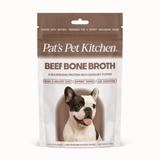
- Fussy eater, poor appetite, or eating awkwardly because of a sore mouth: Beef Bone Broth (£24.99). A 180g powder mixed with warm water, 100 per cent beef and roughly 40 per cent collagen. Useful for getting food and fluid into a dog who has gone off their dinner.
Follow the serving guide above based on your dog's weight. Pick one and give it 8 to 12 weeks before judging it.
Sources
O'Neill DG, Packer RMA, Lobb M, Church DB, Brodbelt DC, Pegram C. Demography and commonly recorded clinical conditions of Chihuahuas under primary veterinary care in the UK in 2016. BMC Veterinary Research, 2020, 16:42. bmcvetres.biomedcentral.com/articles/10.1186/s12917-020-2258-1
Royal Veterinary College VetCompass. World's smallest dogs prone to health problems despite rising popularity. rvc.ac.uk/vetcompass
O'Neill DG, Meeson RL, Sheridan A, Church DB, Brodbelt DC. The epidemiology of patellar luxation in dogs attending primary-care veterinary practices in England. Canine Genetics and Epidemiology, 2016. cgejournal.biomedcentral.com/articles/10.1186/s40575-016-0034-0
Kiviranta AM, Rusbridge C, Lappalainen AK, Junnila JJT, Jokinen TS. Persistent fontanelles in Chihuahuas. Part I. Distribution and clinical relevance. Journal of Veterinary Internal Medicine, 2021, 35(4). onlinelibrary.wiley.com/doi/10.1111/jvim.16151
Dobenecker B, Böswald LF, Reese S, Steigmeier-Raith S, Trillig L, Oesser S, Schunck M, Meyer-Lindenberg A, Hugenberg J. The oral intake of specific Bioactive Collagen Peptides (BCP) improves gait and quality of life in canine osteoarthritis patients. PLOS ONE, 2024, 19(9). journals.plos.org/plosone
PDSA. Chihuahua breed information. pdsa.org.uk
PDSA. Luxating patella in dogs. pdsa.org.uk
PDSA. Obesity in dogs. pdsa.org.uk
The Kennel Club. Breed Standard: Chihuahua (Smooth Coat). royalkennelclub.com
The Kennel Club. Breed Watch: Chihuahua (Smooth Coat), Category 2. royalkennelclub.com
American College of Veterinary Surgeons. Patellar Luxations. acvs.org
American College of Veterinary Surgeons. Tracheal Collapse. acvs.org
Cornell University College of Veterinary Medicine, Riney Canine Health Center. Patellar luxation. vet.cornell.edu
Cornell University College of Veterinary Medicine, Riney Canine Health Center. Tracheal collapse. vet.cornell.edu
Today's Veterinary Practice. Canine Patellar Luxation: Diagnosis and Treatment Options for General Practitioners. todaysveterinarypractice.com
Canine Arthritis Management. Weight management in arthritic dogs. caninearthritis.co.uk
Canine Arthritis Management. Identifying the signs: does my dog have arthritis? caninearthritis.co.uk
West Midlands Referrals. Radius and ulna fractures in small breed dogs. wm-referrals.com
Disclaimer: This information is for educational purposes and doesn't replace veterinary advice. If your Chihuahua is skipping on a back leg, limping, coughing, reluctant to jump or off their food, consult your vet for proper diagnosis and treatment. Early intervention gives the best outcomes.
Last Updated: August 2026