Quick Answer: Collagen is the most abundant protein in your dog's body, providing structural support for joints, skin, gut lining, and bones. As dogs age, natural collagen production declines, leading to joint stiffness, dull coats, and mobility issues. Hydrolysed collagen peptides are the only form that absorbs effectively. Most dogs show visible improvements within 4-6 weeks of daily supplementation.
---
Your dog is slowing down.
The stairs are harder. The morning stiffness lasts longer. The coat that used to shine looks dull.
These aren't separate problems. They're all connected to one thing: your dog's collagen levels are dropping.
This guide covers everything you need to know about collagen for dogs: what it does, why it matters, which type actually works, and how to choose the right supplement.
---
What Is Collagen?
Collagen is a structural protein. It's the scaffolding that holds your dog's body together.
It makes up approximately 30% of your dog's total protein content. That makes it the single most abundant protein in their body.
Where collagen is found
-
Joints: Forms the cartilage, tendons, and ligaments that allow smooth movement
-
Skin: Creates the structural layer that keeps skin elastic and hydrated
-
Gut lining: Provides amino acids that maintain intestinal wall integrity
-
Bones: Creates the protein matrix that gives bones their strength and flexibility
-
Nails and paw pads: Provides structure and resilience
Think of collagen like the steel reinforcement inside concrete. Without it, structures crumble.
---
Why Dogs Lose Collagen as They Age
Your dog's body constantly produces new collagen while breaking down old collagen. In young, healthy dogs, production keeps pace with breakdown.
But from around age 5-7 (earlier in large breeds), production starts to slow while breakdown continues at the same rate.
The result: a net loss of collagen, year after year.
Factors that accelerate collagen loss
-
Age: The primary factor. Production naturally declines with age.
-
Size: Large and giant breeds experience faster joint wear due to greater load.
-
Activity level: Working dogs and highly active dogs use collagen faster.
-
Previous injury: Damaged tissue requires more collagen for repair.
-
Breed predisposition: Some breeds are genetically prone to joint issues.
-
Poor nutrition: Lacking the building blocks needed for collagen synthesis.
---
Signs Your Dog May Need Collagen Support
Collagen deficiency doesn't happen overnight. It's gradual, which is why many owners miss the early signs.
Joint and mobility signs
-
Stiffness after rest, especially in the morning
-
Hesitation before jumping (into car, onto furniture)
-
Slower on walks or reluctance to walk as far
-
Difficulty with stairs
-
Limping or favouring one leg
Skin and coat signs
-
Dull, dry coat that's lost its shine
-
Flaky or itchy skin
-
Slow wound healing
Other signs
-
Brittle or cracked nails
-
Digestive issues (collagen supports gut lining)
-
General loss of vitality
---
What Collagen Supplementation Actually Does
When you give your dog hydrolysed collagen peptides, those peptides are absorbed through the gut and travel through the bloodstream.
Research shows these peptides accumulate in cartilage and other connective tissues, where they serve two functions:
-
Provide building blocks: The amino acids (particularly glycine, proline, and hydroxyproline) are used to synthesise new collagen.
-
Stimulate production: Studies indicate collagen peptides may signal the body to increase its own collagen production.
This is different from painkillers, which mask symptoms. Collagen supplementation addresses the underlying structural issue.
---
Understanding Collagen Types
There are at least 28 types of collagen identified in mammals. For dogs, three types matter most:
Type I Collagen
-
The most abundant type (90% of total body collagen)
-
Found in skin, bones, tendons, ligaments
-
Provides tensile strength
Type II Collagen
-
Found primarily in cartilage
-
Makes up a smaller percentage of total body collagen
-
Specific to joint cushioning
Type III Collagen
-
Found alongside Type I in skin and blood vessels
-
Important for skin elasticity
-
Supports gut lining
What this means for supplementation: Types I and III together support the entire joint structure (tendons, ligaments, connective tissue) plus skin, gut, and bones. Type II specifically targets cartilage. Most comprehensive supplements focus on Types I and III because they address whole-body collagen needs.
---
Why Hydrolysed Collagen Peptides Matter
This is the most important thing to understand about collagen supplementation.
Standard collagen molecules are too large to absorb effectively.
Native collagen has a molecular weight of around 300,000 Daltons. It's a large, tightly wound triple helix that resists digestion. Most of it passes through the gut without being absorbed.
Hydrolysed collagen peptides are different.
Hydrolysis breaks the collagen down into small peptide chains, typically 2,000-5,000 Daltons. These are small enough to be absorbed through the intestinal wall and into the bloodstream.
The absorption difference
-
Native collagen: Poor absorption, most passes through undigested
-
Hydrolysed peptides: Studies show up to 90% intestinal absorption
This is why you should only choose supplements that specifically state "hydrolysed collagen peptides" on the label. Anything else is likely wasting your money.
---
Which Dogs Benefit from Collagen?
The short answer: most dogs, at some point in their life.
Dogs that benefit most
-
Senior dogs (7+ years): Natural collagen production has declined significantly
-
Large and giant breeds: Greater joint stress, faster wear
-
Dogs with diagnosed joint conditions: Hip dysplasia, arthritis, luxating patella
-
Working and active dogs: Higher collagen turnover from activity
-
Post-surgery recovery: Supports tissue repair
-
Dogs with skin or coat issues: Collagen supports skin barrier function
Prevention vs treatment
Collagen works for both, but prevention is easier than repair.
Starting supplementation before joint problems develop (from age 3-5 in large breeds, 5-7 in smaller breeds) helps maintain collagen levels rather than trying to rebuild depleted stores.
---
Collagen vs Other Joint Supplements
How does collagen compare to other common joint supplements?
Collagen vs Glucosamine
-
Glucosamine: Supports cartilage specifically, helps maintain joint fluid
-
Collagen: Supports entire joint structure (cartilage, tendons, ligaments) plus skin, gut, bones
-
Verdict: Different mechanisms. Can be used together for comprehensive support.
Collagen vs Fish Oil (Omega-3)
-
Fish oil: Anti-inflammatory, doesn't rebuild tissue
-
Collagen: Provides building blocks for tissue repair
-
Verdict: Complementary. Fish oil manages inflammation while collagen rebuilds.
Collagen vs Green-Lipped Mussel
-
Green-lipped mussel: Contains omega-3s and glycosaminoglycans, anti-inflammatory
-
Collagen: Direct structural support
-
Verdict: Can be combined. Different mechanisms of action.
---
What to Look for in a Collagen Supplement
Must-haves
-
Hydrolysed collagen peptides: Non-negotiable. Without this, absorption is poor.
-
Clear dosing instructions: Based on your dog's weight.
-
Quality sourcing: Ideally grass-fed bovine or sustainably sourced marine.
Nice-to-haves
-
Powder form: Easier to dose accurately, mixes into food
-
Tasteless and odourless: Fussy eaters won't reject it
-
Made in UK: Quality control, shorter supply chain
Red flags to avoid
-
No mention of "hydrolysed" (likely poor absorption)
-
Vague ingredient lists
-
Lots of fillers and additives
-
Unrealistic claims ("instant results", "miracle cure")
---
What Results to Expect (And When)
Collagen supplementation isn't instant. You're rebuilding tissue, not masking pain.
Typical timeline
-
Week 1-2: Usually no visible changes yet
-
Week 2-3: Coat may start to look shinier (often the first visible sign)
-
Week 4-6: Mobility improvements often become noticeable
-
Week 6-8+: Continued improvement, sustained benefits
What affects results
-
Severity of existing issues: Mild issues respond faster than severe ones
-
Consistency: Daily supplementation without skipping
-
Correct dosing: Under-dosing produces poor results
-
Overall health: Weight management and appropriate exercise support results
Give it at least 6-8 weeks of consistent daily use before deciding if it's working.
---
How to Give Collagen to Your Dog
Serving size
Follow the serving guide on your product's pouch based on your dog's weight. This ensures correct dosing for your dog's size.
How to give it
-
Sprinkle directly onto food (wet or dry)
-
Mix into food thoroughly
-
Can be mixed with a little water first if preferred
When to give it
Timing doesn't matter. Morning, evening, or split between meals. Consistency matters more than timing.
For fussy eaters
Pure collagen powder is tasteless and odourless. Most dogs don't notice it. If your dog is extremely fussy, try mixing it with a small amount of wet food first, or use Beef Bone Broth which has an appealing flavour.
---
Is Collagen Safe for Dogs?
Yes. Collagen is a natural protein that dogs consume whenever they eat meat, bones, or connective tissue.
Side effects
Rare. Some dogs with very sensitive stomachs may experience mild digestive upset initially. If this happens, start with half the recommended amount for a week, then increase gradually.
Interactions
Collagen is a food supplement, not a medication. It doesn't interact with most medications. However, if your dog is on any medication, check with your vet before adding any new supplement.
Puppies
Generally safe from 6 months of age. Puppies naturally produce plenty of collagen, so supplementation is usually unnecessary unless your vet recommends it for a specific reason.
---
Frequently Asked Questions
How long should my dog take collagen?
Indefinitely, for ongoing support. Collagen supplementation maintains levels. If you stop, levels will gradually decline again. Think of it as maintenance, not a short-term treatment.
Can I give human collagen supplements to my dog?
The collagen itself is often similar, but human supplements may contain additives, sweeteners, or flavourings that aren't suitable for dogs. Use products formulated specifically for dogs.
Is bone broth the same as collagen?
Bone broth contains collagen (typically 30-40% of the protein content) plus other nutrients like minerals and gelatin. It's a whole-food approach. Pure collagen supplements provide higher, more concentrated collagen content.
Will collagen help my dog's arthritis?
Collagen provides structural support to joints affected by arthritis. It doesn't cure arthritis, but it can support joint function and comfort. Many owners report improvements in mobility. For dogs with diagnosed arthritis, consult your vet about incorporating collagen alongside other management strategies.
What's better: collagen powder or chews?
Powder is generally more practical: easier to dose accurately, mixes invisibly into food, and doesn't require fillers or binders to hold a chew shape. Chews are convenient but often contain lower doses and additional ingredients.
---
Choosing the Right Collagen Product
For general wellness and prevention
Pure Collagen provides 100% hydrolysed collagen peptides with nothing else added. Ideal for healthy dogs of all ages who need foundational support for joints, skin, coat, and gut.
For dogs with existing joint issues
Mobility & Joints combines collagen peptides with glucosamine, hyaluronic acid, and vitamins C and E. This 6-in-1 formula addresses joint problems from multiple angles for dogs already showing stiffness or mobility issues.
For gut health and fussy eaters
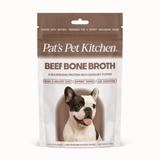
Beef Bone Broth contains 40% collagen plus natural gelatin and minerals. The irresistible beef flavour makes it perfect for picky eaters, and the gelatin provides additional gut-soothing benefits.
Follow the serving guide on your chosen product's pouch based on your dog's weight.
---
Important: This information is for educational purposes and doesn't replace veterinary advice. If your dog is showing signs of joint problems, pain, or mobility issues, consult your vet for proper diagnosis and treatment. The guidance in this article is based on current veterinary research and best practices, but every dog is different.
Last Updated: February 2026