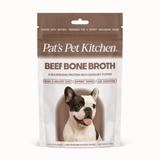
Quick Answer: Bone broth is a nutritious, collagen-rich food you can make at home for your dog using animal bones, water, and a slow simmer. Five simple recipes use beef, chicken, turkey, pork, and fish as bases. Each takes 12 to 48 hours to extract maximum nutrition. If home cooking isn't practical, Beef Bone Broth offers 40% collagen with no prep, zero waste, and consistent quality every time.
Your dog watches you eat. They catch the smell of roasted chicken or beef stock simmering on the hob. Their nose twitches. They sit very still, hoping you'll slip them a taste.
You know bones aren't for sharing with dogs the way humans think of them. But bone broth is different. It's liquid nutrition. No choking hazards. Pure goodness extracted over hours of slow cooking.
Making bone broth at home gives you complete control over what goes into your dog's bowl. No additives, no fillers. Just bones, water, and time. Your dog gets the benefit of collagen, gelatin, amino acids, and minerals that support joint health, gut function, and overall wellbeing.
Here are five simple, safe recipes you can make in your own kitchen.
Why Make Bone Broth at Home?
Bone broth is trending in human nutrition for good reason. The science applies to dogs too.
When you slowly simmer bones, the collagen in the bone matrix breaks down into gelatin and hydrolysed collagen peptides. These are absorbed by your dog's digestive system and incorporated into their own connective tissues, cartilage, and gut lining. Bone broth also contains glycine, proline, and glutamine, amino acids that support joint repair and intestinal health.
The minerals leached from bones (calcium, magnesium, phosphorus, potassium) are highly bioavailable, meaning your dog's body can use them efficiently. This is why bone broth feels like such a complete food to so many dog owners.
Making it yourself costs less than buying commercial bone broth. You know exactly what's in the pot. No gelling agents, no thickeners. Just slow, patient extraction of nutritional goodness.
Safety First: Rules for Dog Bone Broth
Start with raw bones, and never give your dog a cooked bone to chew. These are two separate points and both matter. For making broth, begin with raw bones. That gives you control over quality and lets the long, slow simmer do its work. Once those bones have been cooked, they are brittle and splinter easily, which is why every recipe below strains them out and bins them. A cooked bone is an ingredient, never a chew. Handing one to your dog risks sharp fragments damaging the mouth, throat, or gut.
Remove all meat completely before serving to reduce fat content and spoilage risk. You can cook a little meat on the bones for flavour, but scrape it off before giving the broth to your dog.
Do not add garlic, onions, or leeks. These are toxic to dogs. Keep the pot plain: bones, water, and at most a few safe vegetable scraps.
Cool the broth completely before storing. Strain out all bone fragments and impurities through a fine sieve or cheesecloth.
Store properly: Refrigerated in a sealed container for up to 5 days, or frozen in ice cube trays for 3 months. Frozen portions are convenient for serving.
Start small. Introduce bone broth gradually, especially if your dog isn't used to it. Begin with 25 to 50ml per day, mixed with their regular food, then increase over a week.
Recipe 1: Beef Bone Broth
Ingredients
- 2 to 3kg raw beef bones (marrow bones, knuckles, or joint bones work best)
- 2 litres of filtered water (or more to cover bones by 5cm)
- 1 tablespoon apple cider vinegar (optional, helps extract minerals)
- A few vegetable scraps: carrot, celery, or parsnip (optional, for flavour)
Method
Place raw beef bones in a large pot and cover with cold water. Add apple cider vinegar if using. Bring slowly to a simmer, then immediately reduce heat to very low. A proper bone broth simmers, never boils. Skim any grey foam that rises to the surface during the first 30 minutes.
Simmer for 24 to 48 hours. Longer simmering extracts more collagen and minerals. After 24 hours, strain the broth through a fine sieve lined with cheesecloth into a clean container. Discard bones and solids. Those bones are now cooked, so they go in the bin rather than to your dog.
Cool completely, then refrigerate. A layer of fat will solidify on top. You can leave this for flavour or skim it off if you prefer lower fat content.
Storage
Refrigerated: up to 5 days in a sealed container. Frozen: pour into ice cube trays and freeze, then transfer cubes to freezer bags for 3 months. One cube equals roughly 30ml.
Serving
Mix 50 to 100ml into your dog's regular meal, or serve as a warm drink on cold days. For a 25kg dog, aim for 200 to 300ml per day spread across meals.
Recipe 2: Chicken Bone Broth
Ingredients
- Bones from 2 whole raw chickens (or 1.5 to 2kg raw chicken frames)
- 2 litres filtered water (or enough to cover bones)
- 1 tablespoon apple cider vinegar (optional)
- A few celery or carrot scraps (optional)
Method
Place raw chicken bones in a pot, cover with cold water, and add vinegar if using. Bring to a gentle simmer over medium heat, then reduce to very low. Chicken bones are more delicate than beef, so keep the heat low to avoid breaking them down too fast.
Simmer for 12 to 24 hours. Chicken broth takes less time than beef because the bones are softer. Skim any foam in the first 30 minutes.
Strain through cheesecloth into a clean container and cool completely. Discard the cooked bones. Refrigerate or freeze as above.
Storage
Refrigerated: up to 4 days. Frozen: 3 months in ice cube trays or portion containers.
Serving
Chicken broth is lighter than beef, so you can increase portions slightly: 75 to 150ml per day for a medium dog. Many dogs find chicken more palatable than beef.
Recipe 3: Turkey Bone Broth
Ingredients
- Bones from 1 raw turkey carcass (or 2 to 2.5kg raw turkey bones)
- 2 to 3 litres filtered water
- 1 tablespoon apple cider vinegar (optional)
- Vegetable scraps: carrot, celery, or courgette (optional)
Method
Break the turkey carcass into manageable pieces and place in a large pot. Cover with cold water and add vinegar. Bring to a gentle simmer, skim any foam, then reduce to very low heat.
Simmer for 18 to 36 hours. Turkey bones release excellent collagen and minerals. The longer you simmer, the richer the broth becomes.
Strain through cheesecloth and cool completely before storing. Bin the cooked bones.
Storage
Refrigerated: up to 4 days. Frozen: 3 months.
Serving
Turkey broth is slightly richer than chicken. Serve 50 to 120ml per day mixed into meals. It's an excellent choice for dogs recovering from illness or needing appetite support.
Recipe 4: Pork Bone Broth
Ingredients
- 1.5 to 2kg raw pork bones (knuckle joints, ribs, or spine bones)
- 2 litres filtered water
- 1 tablespoon apple cider vinegar (optional)
- A few carrot or celery scraps (optional)
Method
Place raw pork bones in a pot and cover with cold water. Add vinegar. Bring slowly to a simmer, skim foam, then reduce to very low heat.
Simmer for 24 to 40 hours. Pork bones hold their structure well during long cooking and release robust collagen. The longer simmer produces a richer, more gelatinous broth.
Strain through cheesecloth and cool completely. Discard the cooked bones.
Storage
Refrigerated: up to 5 days. Frozen: 3 months.
Serving
Pork broth is rich and full-bodied. Serve 50 to 100ml per day, mixed into meals or as a warm drink. It's particularly good for dogs that struggle with appetite or need extra calories.
Recipe 5: Fish Bone Broth
Ingredients
- Fish bones and heads from raw fish (salmon, cod, or mackerel; 500g to 1kg)
- 1.5 litres filtered water
- 1 tablespoon apple cider vinegar (optional)
- A splash of lemon juice (optional, balances flavour)
Method
Place raw fish bones and heads in a pot, cover with cold water, and add vinegar if using. Fish broth works best at a gentle, rolling simmer, not a hard boil.
Simmer for 4 to 8 hours only. Fish bones are delicate and over-cooking produces a bitter flavour. Six hours is ideal for extracting maximum nutrition without off-flavours.
Strain carefully through fine cheesecloth, removing all fine bone fragments. Cool completely.
Storage
Fish broth has a shorter shelf life. Refrigerated: up to 3 days. Frozen: 2 months in ice cube trays.
Serving
Fish broth is lighter and benefits from less frequent serving. Use 25 to 50ml per day, mixed into meals. Fish bones provide omega-3 fatty acids, which support coat health and reduce inflammation. Use fish broth sparingly if your dog isn't accustomed to it, as some dogs find it too strong.
A Practical Alternative: PPK Beef Bone Broth
Making bone broth at home is rewarding, but it's not always practical. It takes time, planning, and space on your hob for 24 to 48 hours. Bones need sourcing. Mistakes can happen. Batches vary.
This is where Beef Bone Broth from PPK fills the gap. It's crafted to deliver exactly what home-made broth does, without the uncertainty.
40% collagen content means every serving delivers concentrated protein and amino acids. You get the gelatinous texture and nutritional density of a slow-simmered home broth without the labour.
Consistent quality. Every pouch contains the same nutrient profile. No guessing whether you simmered long enough, or whether this batch is richer than last month's batch. Consistency matters, especially if your dog has specific health needs.
Zero waste, zero prep. No sourcing raw bones, no cleaning up fat and impurities, no storage space lost to ice cube trays. Open the pouch, mix the powder with warm water, follow the serving guide. That's it.
Convenient feeding. Use it as a topper, mix it into meals, or offer it warm on a cold day. It works exactly like home-made broth, but without the hours of planning.
Whether you choose to make bone broth at home or use a ready-made option, the nutritional goal is the same: supporting your dog's joints, gut health, and overall wellbeing with high-quality collagen and amino acids.
Frequently Asked Questions
Can I use cooked bones for broth?
For these recipes, start with raw bones. The point that trips people up is what happens afterwards. Once bones have been simmered, they are brittle and splinter easily, which is exactly why every recipe here strains them out and bins them. Never give a dog a cooked bone to chew, whether it came out of your broth pot or off your Sunday roast. If you want to give your dog a bone as a chew, that is raw bones only, under supervision, and it comes with its own set of safety rules.
How do I know when the broth is done?
A well-made bone broth should gel when cooled. If it sets into a jelly-like consistency in the refrigerator, you've extracted good collagen. If it stays liquid, the broth is still nutritious but less collagen-rich. Longer simmering time increases gelatinisation.
Is the fat in bone broth good for dogs?
Yes, in moderation. The fat from bones contains fat-soluble vitamins and is a source of calories. Most dogs benefit from the fat. If your dog has pancreatitis or needs a low-fat diet, skim the solidified fat layer off before serving, or use a commercial broth made with lower fat.
Can I add vegetables to bone broth for extra nutrition?
A few scraps of carrot, celery, or courgette add flavour and minerals, but keep quantities small. Never add onions, garlic, leeks, or anything toxic. Remember that bone broth is a supplement to a balanced diet, not a complete food in its own right.
What's the best way to serve bone broth?
Most simply, mix it into your dog's regular meal. You can also serve it warm as a drink on cold days or pour it over dry kibble to make it more interesting. Some owners use it as a base for homemade meals. Start with small amounts and increase over a week.
Can puppies have bone broth?
Yes. Bone broth is gentle and supports growing bones and joints. Start with small quantities: 25ml once daily, mixed into meals. Puppies from around 8 weeks can safely enjoy bone broth.
How much bone broth should my dog have daily?
For a medium dog (20 to 30kg), 100 to 200ml daily is typical. Smaller dogs need less, larger dogs may have more. Follow the serving guide if using a commercial product. With home-made broth, start conservatively and increase based on your dog's response. Broth shouldn't replace a balanced diet; it complements it.
Can I freeze bone broth in ice cube trays?
Absolutely. This is the most convenient storage method. Pour cooled broth into ice cube trays, freeze solid, then transfer to freezer bags. One cube is typically 25 to 30ml. Thaw at room temperature or gently warm before serving.
Which Product for Your Dog?
- Interested in making bone broth at home: Follow the recipes above. Start with beef or chicken for easiest results.
- Want convenience without preparation: Beef Bone Broth (40% collagen, a powder you mix with warm water)
- Looking to support joints alongside bone broth: Pure Collagen (6,000mg hydrolysed collagen for maintenance)
- Joint support with additional supplements: Mobility & Joints (collagen plus glucosamine, hyaluronic acid, and vitamins)
Follow the serving guide on your chosen product's pouch based on your dog's weight.
Sources
- Schunck M, et al. "Oral Administration of Specific Bioactive Collagen Peptides in a Randomised Controlled Study Improves Cartilage Metabolism in Subjects with Active Lifestyle." Nutrients, 2018.
- Schwartz SR, et al. "Collagen Composition of Articular Cartilage and Changes in Osteoarthritis." Journal of Orthopaedic Research, 2015.
- The Kennel Club. Responsible feeding guidelines. thekennelclub.org.uk
- PDSA. Preparing food for your pet. pdsa.org.uk
- American Kennel Club. Home-cooked dog food safety. akc.org
Disclaimer: This information is for educational purposes and doesn't replace veterinary advice. Bone broth is a nutritious food, but always introduce new foods gradually. If your dog has digestive sensitivities, pancreatitis, or other health conditions, consult your vet before adding bone broth to their diet. This information doesn't diagnose or treat medical conditions.
Last Updated: July 2026