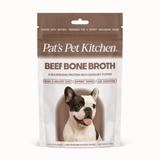
Quick Answer: Collagen supports your dog's gut health through amino acids like glycine and glutamine, which strengthen the intestinal barrier. A healthy gut reduces inflammation throughout the body, including in the joints. This gut-joint connection means that supporting digestive health with collagen supplements like Beef Bone Broth can help your dog feel more comfortable and mobile.
Your dog scratches at their skin more than usual. Their energy dips mid-afternoon. They leave half their dinner in the bowl. You wonder if something is off. It might not be obvious at first, but these small changes often point to digestive stress.
Most dog owners focus on joints when they think about supplements. But your dog's gut is where the real foundation sits. A strong intestinal barrier keeps harmful substances out. A damaged one lets inflammation in. And once inflammation starts in the gut, it travels everywhere. Joints, skin, energy levels, coat quality. Everything suffers.
The connection between gut health and joint health is real. It is not a wellness trend. It is biology.
What Is the Gut-Joint Connection?
Your dog's intestinal lining is made partly of collagen. This lining acts as a barrier between the contents of the digestive tract and the bloodstream. When this barrier is strong, only properly digested nutrients pass through. Everything else stays out.
Intestinal permeability (often called "leaky gut") happens when this barrier breaks down. Larger molecules, pathogens, and partially digested food particles slip through into the bloodstream. The immune system flags these as invaders. Inflammation spreads. The body responds by protecting itself.
Here is where joints come in. Chronic gut inflammation triggers inflammation throughout the body. Joints become a target. Cartilage breaks down faster. Mobility suffers. Your dog moves less. They feel stiffer.
Fixing the gut often improves joint health without directly treating the joints. This is the gut-joint axis at work.
How Collagen Supports the Gut Barrier
Collagen contains three amino acids that directly support gut health. Glycine, proline, and glutamine. These are not optional extras. They are structural building blocks.
Glycine: This amino acid makes up about one-third of collagen. It supports the production of glutathione, a powerful antioxidant that protects gut cells from damage. Glycine also helps regulate stomach acid and supports the production of digestive juices.
Glutamine: The intestinal lining relies on glutamine as fuel. Stressed guts deplete glutamine rapidly. When glutamine is low, the barrier weakens. Supplementing glutamine directly supports intestinal cell repair and strengthens the tight junctions that keep harmful substances out.
Proline: Like glycine, proline is structural. It cross-links collagen molecules and strengthens the physical integrity of the intestinal wall.
When you add hydrolysed collagen to your dog's diet, these amino acids absorb easily and accumulate in tissues that need them most. The gut barrier gets the support it needs to repair and maintain itself.
Signs Your Dog's Gut Health Needs Support
Gut issues often hide in plain sight. They do not always look like acute digestive distress.
Inconsistent stools: Alternating between loose and firm. Not always diarrhoea, but not perfectly normal either.
Reduced appetite or pickiness: Your dog eats less or becomes fussy with food they usually enjoy.
Excessive scratching or skin irritation: Gut inflammation often shows up as itchy skin. The two are connected more than most owners realise.
Low energy or lethargy: Poor nutrient absorption means less fuel for your dog's cells.
Dull coat or hair loss: A healthy coat starts with nutrient availability. Gut inflammation blocks it.
Gas or bloating: Undigested food fermenting in the intestines.
Stiffness that improves with movement: This is often joint-related, but if your dog also shows gut signs, inflammation is the common cause.
If your dog shows any of these, see your vet first. Rule out infection, food allergy, or underlying conditions. Once you have a clear picture, collagen supplementation can support recovery.
Beef Bone Broth for Gut Health
Among collagen sources, Beef Bone Broth stands out for gut support. Here is why.
Bone broth is simmered bone, cartilage, and connective tissue. The long cooking process breaks down collagen into gelatin and amino acids. Your dog absorbs these without needing further digestion. The process is gentler than feeding raw joints or chews.
Collagen content: Our Beef Bone Broth contains 40% collagen by weight. That is a significant amount in a single serving.
Natural gelatin: Gelatin is cooked collagen. It absorbs water in the digestive tract and creates a soothing effect on the intestinal lining. Many dogs with sensitive guts respond well to gelatin.
Trace minerals: Bone broth includes calcium, magnesium, and phosphorus. These minerals support gut pH balance and nutrient absorption.
Palatability: Bone broth tastes like food, not a supplement. Fussy eaters accept it more readily. It also encourages hydration, which supports digestive health.
Start slowly if your dog has a sensitive gut. A small amount mixed into food for the first week, then increase gradually. This prevents digestive upset as beneficial bacteria adjust to the new nutrition.
Follow serving guide on your chosen product's pouch based on your dog's weight.
Beyond Collagen: Other Practical Steps for Gut Health
Supplements support gut health. They do not replace other foundations.
Feed consistently. Gut bacteria thrive on routine. Feed at the same times each day. Avoid frequent food changes. When you do change food, transition over 7-10 days by mixing old and new.
Avoid common gut irritants. High-fat scraps, excess treats, and sudden diet changes all stress the gut barrier. So do some commercial additives and low-quality ingredients. Read labels.
Manage stress. Stress hormones affect gut barrier function. Anxious dogs often have loose stools. Regular exercise, consistent routine, and a calm environment all support digestive health.
Prioritise hydration. A well-hydrated dog has healthier digestion. Fresh water throughout the day is non-negotiable. Bone broth also contributes hydration.
Consider feeding structure. Some dogs digest better with meals split into two smaller portions rather than one large one. Others benefit from slightly warm food rather than cold.
Avoid over-supplementation. More is not better. Stick to recommended serving sizes. Too many supplements can actually stress a sensitive gut.
What Results to Expect
Gut healing takes time. Do not expect overnight results.
Week 1-2: Some dogs show slightly improved appetite or energy. Others show no visible change yet. This is normal. The intestinal barrier is beginning to receive amino acid support, but repair is not visible from outside.
Week 3-4: Stools often become more consistent. This is usually the first sign that the gut barrier is responding. Skin scratching may begin to reduce.
Week 4-8: Energy levels often improve noticeably. Coat quality improves. If your dog has joint issues, stiffness may reduce as whole-body inflammation drops.
Week 8-12: Most dogs show measurable improvement by week 12. Consistent stools, better appetite, shinier coat, improved mobility.
Remember: collagen supports gut healing. It does not cure underlying conditions like food allergies or inflammatory bowel disease. These require veterinary management. Collagen supplements work alongside treatment, not instead of it.
Frequently Asked Questions
Can I give bone broth to a dog with a sensitive stomach? Yes, but introduce it slowly. Start with a small amount mixed into food for 3-5 days. If digestion is stable, increase gradually to the full recommended serving. Bone broth is usually well tolerated because it is pre-digested by simmering.
Is collagen the same as gelatin? Collagen is the raw protein. Gelatin is cooked collagen. Both support the gut, but gelatin is easier to digest because the long cooking process has already broken it down. Bone broth contains both.
How long do I need to supplement for? Ongoing. Your dog's gut benefits from continuous collagen support, just like it needs continuous nutrition. Once you see results, keep going. You can reduce frequency if advised by your vet, but stopping altogether usually means symptoms return.
Will collagen help my dog's joints directly? Yes, directly and indirectly. Directly: collagen provides amino acids for cartilage. Indirectly: collagen heals the gut, reduces whole-body inflammation, and allows better nutrient absorption for joint health overall. The gut-joint connection means one supports the other.
Can I give bone broth alongside other supplements? Yes. Bone broth stacks well with other joint supplements. If your dog has both gut and joint concerns, Beef Bone Broth for gut support paired with Mobility and Joints for existing joint issues gives comprehensive support. Always follow serving guides on each pouch.
Is bone broth safe for puppies? Yes, from approximately 8 weeks. Introduce gradually in small amounts. Puppies have developing guts and benefit from early collagen support for both immediate digestive health and long-term joint health.
Which Product for Your Dog?
Your dog's specific situation guides the choice:
Sensitive or inconsistent digestion, fussy eater, or recovery from illness: Beef Bone Broth
Healthy dog with joint mobility concerns: Mobility and Joints
Healthy dog for long-term joint maintenance: Pure Collagen
Both digestive and joint concerns: Start with Beef Bone Broth for 4-6 weeks, then consider adding Mobility and Joints for additional joint support. Follow serving guides on your chosen product's pouch based on your dog's weight.
Sources
Koutroulos, G., et al. (2016). Dietary hydrolyzed collagen peptides increase bone mineral density in ovariectomized rats. Journal of Nutritional Science, 5:e14.
Ohara, H., et al. (2010). Effects of Pro-Hyp, a collagen-derived di-peptide, on bone turnover in growing and mature rats. Journal of the Science of Food and Agriculture, 90(11), 1932-1937.
British Veterinary Association. Canine Health Schemes. https://www.bva.co.uk/
British Small Animal Veterinary Association. BSAVA Manual of Canine and Feline Gastroenterology. 2nd edn. Gloucester: BSAVA, 2012.
Canine Arthritis Management (CAM) UK. Evidence-based information on canine osteoarthritis and joint health.
Valenzuela, C. A., et al. (2020). Marine and terrestrial plant sources of omega-3 and omega-6 polyunsaturated fatty acids and their effect on inflammation in canine health. Veterinary Medicine and Science, 6(2), 198-210.
Disclaimer: This information is for educational purposes and does not replace veterinary advice. If your dog shows signs of gut distress, poor appetite, or joint stiffness, consult your vet for proper diagnosis and treatment. Early intervention gives the best outcomes.
Last Updated: March 2026