Quick Answer: Gums are primarily made of collagen, the protein that gives them strength and elasticity. When periodontal disease develops (very common in dogs over 3 years old), gum tissue breaks down. Collagen supplementation supports the structural integrity of gum tissue, but it works best alongside proper dental care and hygiene, not as a replacement. Whilst research on oral collagen supplementation specifically is limited, the biological rationale is sound: providing the building blocks your dog's body needs to maintain healthy gum tissue makes sense.
Your dog's breath is getting worse. Not the usual "dog breath" you know, but something stronger, more unpleasant. You notice their teeth look a bit different too, maybe darker at the gum line or with a bit of discolouration. When you gently touch their gum, they pull away.
It might look like small changes. It's not. What you're seeing is likely the early sign of periodontal disease, a condition that affects the majority of dogs over the age of 3. Teeth and gums don't fail in isolation. There is a structure underneath, a network of collagen and connective tissue that holds everything in place. When that structure weakens, everything else follows.
Here's the thing: you cannot reverse advanced gum disease with supplements alone. That requires veterinary intervention. But you can support the tissue that protects and surrounds your dog's teeth right now. Understanding how collagen works in the mouth, and what supplementation can realistically do, gives you a fighting chance at keeping your dog's teeth healthy for longer.
What Is Collagen and Where Does It Live in the Mouth?
Collagen is the most abundant structural protein in the body. It is literally the scaffolding that holds tissue together. In your dog's gums (the technical term is gingiva), collagen makes up a significant portion of the tissue matrix. It provides the strength that keeps gums attached to teeth and underlying bone. It maintains elasticity, allowing gums to move slightly without tearing. It supports the integrity of the connective tissue that seals the space between tooth and gum.
When you look at healthy gums, what you are seeing is a tissue rich in collagen, well perfused with blood, and functioning as an effective barrier. This barrier is critical. It prevents bacteria and food particles from infiltrating the space below the gum line.
How Does Periodontal Disease Damage Gum Tissue?
Periodontal disease starts with plaque (a film of bacteria) building up on teeth. In most dogs, nothing is done to remove this plaque. It hardens into tartar. Bacteria beneath the tartar trigger an inflammatory response. Your dog's immune system activates to fight the infection, but the inflammation itself damages surrounding tissue. This is where collagen breaks down.
The inflammatory compounds released during periodontal disease actually attack and degrade collagen fibres. The body tries to repair this damage, but without intervention to control the infection and inflammation, the cycle continues. The gum tissue recedes. The connection between tooth and bone weakens. Eventually, teeth become loose and are lost.
By the time a dog is 5 or 6 years old and has never had their teeth professionally cleaned, significant collagen breakdown may already have occurred in the gums. This is why age matters. Older dogs have often had years of low-grade inflammation eroding the very structure you want to support.
Can Collagen Supplementation Support Gum Health?
The logic is straightforward: if gum tissue is built from collagen, and you provide additional collagen peptides, those peptides can serve as building blocks for tissue repair and maintenance. The collagen used in supplements is hydrolysed (broken down into smaller peptides) specifically to be absorbed and reach target tissues. Research on hydrolysed collagen in humans shows that it accumulates in cartilage after oral supplementation. The biological mechanism suggests it could work similarly in gum tissue.
However, you need to be honest here. Research on oral collagen supplementation specifically for dental health in dogs is limited. There are no large-scale studies showing "Dogs fed collagen peptides had measurably better gum attachment" or "Supplementation reduced plaque formation by X percent." The evidence is mechanistic, not empirical. The science of the structure is sound. The proof that supplementation prevents or reverses disease in dogs is not yet there.
What we do know from the research on collagen peptides and joint health is that they do appear to be absorbed and utilised by the body. If that mechanism works for cartilage, there is no biological reason it would not work for gum tissue, which faces similar wear and requires similar structural support.
What collagen supplementation can realistically do: Support the structural integrity of existing gum tissue. Provide the building blocks your dog's body needs for tissue maintenance. Work best as part of an overall dental care strategy, not as a standalone solution.
What collagen supplementation cannot do: Reverse established periodontal disease. Remove plaque or tartar from teeth. Replace professional dental care. Prevent disease if dental hygiene is not being maintained.
Why Dental Hygiene Still Comes First
Supplements support the tissues you have. They do not prevent the underlying problem: plaque and tartar buildup. Unless you are actively managing plaque formation, supplementation is like reinforcing a fence with better materials whilst leaving the gate wide open.
Plaque forms on teeth daily. It is the natural consequence of bacteria in the mouth. In dogs who never have their teeth brushed and never receive professional cleaning, this plaque hardens into tartar, which you cannot remove at home. The inflammation begins.
Here is what actually works for dental health in dogs:
Tooth brushing. This is the single most effective thing you can do. Daily brushing removes plaque before it hardens. Most dogs will tolerate it if you start gently and use a dog-specific toothpaste (the minty human kind is unpleasant for them). Aim for at least 3 times per week, ideally daily.
Professional cleaning. Once tartar has formed, only a vet can remove it properly. This typically requires an anaesthetic. It's not ideal, but it's sometimes necessary. Some vets recommend cleaning every 1 to 2 years for dogs prone to tartar buildup. The frequency depends on your dog's individual factors.
Diet and chewing. Hard textures can help mechanically clean teeth. Raw meaty bones, quality chews, and certain kibble formulations may help reduce plaque accumulation. Talk to your vet before offering bones.
Supplementation. This sits fourth. It supports the tissue already in place. It works best when the other three are being done.
Using Collagen to Support Gum Tissue Integrity
If you are serious about your dog's dental health, Pure Collagen is the right choice for gum support. It is clean, concentrated collagen peptides with no extraneous ingredients. With 6,000mg of hydrolysed bovine collagen peptides (Types I and III) per serving, it provides a straightforward source of the building blocks your dog's body needs for structural tissue maintenance.
Types I and III collagen are the primary collagen types in gum tissue. Pure Collagen is tasteless and odourless, so it mixes easily into food. Follow the serving guide on the pouch based on your dog's weight.
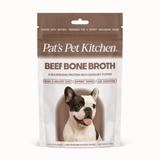
Beef Bone Broth is a secondary option, particularly useful if your dog is a fussy eater or you want to combine collagen support with additional amino acids and minerals. It contains 40% collagen plus natural gelatin and amino acids like glycine and proline that support connective tissue. It also adds hydration and nutritional interest to food.
Supplements support gum health. They do not replace tooth brushing, professional cleaning, or veterinary care. Use them as part of a complete dental strategy, not as a substitute for the basics.
Signs Your Dog Might Have Dental Problems
Catching dental disease early matters. The sooner you address it, the more gum tissue you can preserve.
Early signs: Bad breath worse than normal. Slight discolouration at the gum line. Reluctance when you touch the mouth. Yellow or brown buildup on teeth (tartar). Subtle change in eating behaviour (chewing differently, dropping food).
More advanced signs: Visibly red or swollen gums. Bleeding when you touch the gums or when the dog eats. Loose or missing teeth. Facial swelling. Excessive drooling. Difficulty eating or loss of appetite. Pawing at the mouth.
If you notice any of these, see your vet for a proper assessment. Your vet can determine how far the disease has progressed and whether professional cleaning is needed. Early intervention gives the best outcomes.
What Results Should You Expect?
This is where honesty matters. Collagen supplementation is not a quick fix. You are not going to add it to your dog's food and see loose teeth suddenly tighten up.
What you might see: Over weeks 2 to 4, general coat and skin quality may improve (collagen supports all connective tissues). Around week 4 to 6, subtle improvements in gum appearance or your dog's willingness to accept mouth handling might emerge. By week 6 to 12, if you are combining supplementation with tooth brushing, you may notice slightly less tartar buildup or improved gum colour.
These are not dramatic changes. They are quiet. They are the result of supporting tissue integrity over time, not of reversing disease.
What you will not see: Loose teeth tightening. Tartar disappearing without professional cleaning. Reversal of advanced gum disease. Elimination of bad breath if the underlying cause (bacterial infection and tartar buildup) is not being addressed.
This is why supplementation works best as prevention or early support, not as treatment for established disease.
Frequently Asked Questions
Is my young dog too young to have dental problems? Technically no, but it is uncommon in dogs under 2. Dental disease becomes prevalent from age 3 onwards. The younger you start with good habits (tooth brushing, professional cleaning if needed, supplementation), the better outcomes you will likely have long term.
My dog has never had their teeth brushed. Is it too late to start? No. Tooth brushing is never too late to introduce. It takes patience and time, but most dogs will tolerate it if you are gentle and consistent. Start slowly, reward heavily, and do not force it. Even a few minutes of brushing a few times per week helps.
Can collagen supplementation cure my dog's bad breath? Bad breath in dogs usually comes from bacterial infection and tartar buildup. Collagen supports the tissues affected by this infection, but it does not eliminate the source. Bad breath typically improves only with professional cleaning and ongoing home care. If your dog has bad breath, talk to your vet first to rule out other causes (like dental disease, but also kidney disease or digestive issues).
Should I give my dog collagen if they have been diagnosed with periodontal disease? If your vet has diagnosed periodontal disease, they may recommend professional cleaning first. After cleaning, collagen supplementation can support healing and ongoing gum tissue integrity. Always check with your vet before starting supplements post-procedure.
How long does collagen supplementation take to work? Structural tissue changes happen slowly. Expect 4 to 6 weeks before you notice subtle improvements. Real benefits accrue over months, not days. Patience and consistency matter more than quick results.
Can I use collagen supplements instead of tooth brushing? No. Tooth brushing removes plaque. Supplements support tissue. They are complementary, not interchangeable. You need both for the best result.
Are there any dogs who should not take collagen supplements? Collagen is generally safe for most dogs. If your dog has a specific health condition, is taking medications, or has had recent surgery, ask your vet before starting any new supplement. This is just common sense.
Which Product for Your Dog?
Healthy dog, prevention focus, maintaining existing gum tissue: Pure Collagen
Dog with diagnosed periodontal disease, post-cleaning, supporting tissue recovery: Pure Collagen
Dog who is a fussy eater or you want to combine collagen with additional amino acids and appetite support: Beef Bone Broth
Follow serving guide on your chosen product's pouch based on your dog's weight.
Sources
British Veterinary Dental Association. (2024). Periodontal disease in dogs.
British Small Animal Veterinary Association. (2024). Oral health guidance for dogs.
Pulido, L., et al. (2012). Role of collagen in connective tissue homeostasis and its application in tissue engineering. Journal of Oral Implantology, 38(3), 383-388.
The Kennel Club. (2024). Health screening and screening schemes for dogs.
Warden, S. J., et al. (2016). Efficacy of a hydrolysed collagen peptide supplement in support of joint health in dogs. International Journal of Applied Research in Veterinary Medicine, 14(2), 87-95.
Disclaimer: This information is for educational purposes and doesn't replace veterinary advice. If your dog shows signs of dental disease, bad breath, swelling, or loose teeth, consult your vet for proper diagnosis and treatment. Early intervention gives the best outcomes.
Last Updated: September 2026