Quick Answer: Most dogs show no visible changes in the first 7-10 days. This is normal. Collagen works by building new tissue, not masking symptoms, so it takes time for your dog to feel the benefit. Some owners notice coat and skin improvements between weeks 2-3, whilst mobility changes typically show up after week 3. By week 4-6, many owners report their dog is more willing to exercise and less stiff after resting.
You've just added collagen to your dog's dinner bowl for the first time. You watch them eat it happily, mixed in with their food. Part of you is hopeful. The other part is wondering: how long will this actually take to work? Will I see results next week, or should I be thinking in months?
You're not alone in asking this question. Lots of dog owners start collagen supplements expecting immediate changes, then worry something's wrong when their dog doesn't seem different after a few days. They're thinking about it all wrong.
Collagen doesn't work like a pain reliever. It's not masking anything. It's providing the building blocks your dog's body needs to support stronger joints, healthier skin, and a better coat. That takes time. Here's what the first 30 days actually looks like.
What Happens in Week 1-2: The Absorption Phase
Your dog's body is getting to work immediately, but you won't see it yet. During the first week or two, the hydrolysed collagen peptides are being absorbed through the digestive tract and distributed around the body. Think of it as the supply delivery phase. The building blocks are arriving at the sites where they're needed, but there's nothing visible to observe.
This is where patience matters most. If you're checking your dog every day for changes, you'll feel disappointed. There probably won't be any. That's the design of how supplements work, not a sign it's not working.
What you should be doing instead: keep a simple note of your dog's baseline. How is their coat right now? Dull or shiny? What's their energy level like? Can they jump on the sofa without hesitation, or do they hesitate? Are they stiff after they wake up from a long nap? Write these down. You'll compare against this later.
Week 2-3: Coat and Skin Usually Come First
Most owners notice changes to coat quality and skin condition before they notice anything else. This happens because skin cells turn over quickly, much faster than bone and joint tissue. If your dog's coat was looking dull or their skin was dry, this is where collagen starts to make a visible difference.
You might notice their fur looks slightly shinier or feels softer. Their skin might feel less flaky. Some owners say their dog's paws look less dry. These aren't dramatic changes, but they're real ones, and they're encouraging.
Not every dog will show these signs at the same time, and some dogs won't show them at all. If your dog's coat was already in great condition, you might not notice this phase. That doesn't mean collagen isn't working on their joints. It just means there was less room for visible improvement on the surface.
Week 3-4: Subtle Mobility Shifts
Around the third or fourth week, some owners start noticing small changes in how their dog moves. These are usually subtle. Your dog might be less stiff when they get up after a long rest. They might hesitate less before jumping onto furniture. They might climb stairs with a bit more confidence.
These aren't dramatic transformations. You're not going to see a dog that couldn't move suddenly running about. But you might notice they're a bit more willing. A bit more comfortable. A bit quicker to get up off the floor.
This is because collagen is now being incorporated into joint tissue, cartilage, and connective tissue. The body is using those building blocks to support existing structures and strengthen them gradually.
Week 4-6: The Changes Become More Obvious
By the fourth to sixth week, the changes most owners notice start to become clearer. Your dog might show a genuine increase in willingness to exercise. They might want longer walks. They might fetch for longer without seeming stiff afterwards. The stiffness you used to see when they got out of bed might be much less noticeable.
Some owners describe it as their dog "getting their spring back". Others say their dog seems more like they did years ago, before they started to stiffen up. This is a realistic observation. Collagen is providing the structural support to allow movement that felt uncomfortable before.
Don't expect perfection here. If your dog had serious mobility issues before, collagen won't fix them entirely. But it will support their joint health and make movement easier. That's what it's designed to do.
Why Patience Matters: Understanding How Collagen Works
Collagen doesn't relieve pain or reduce inflammation like a medication does. It works differently. It provides the structural proteins your dog's body uses to build and repair connective tissue. That's a slower process, by design.
Think of your dog's joints like a building. If the walls are crumbling, you need new bricks. Collagen is the bricks. Installing them takes time. First the bricks arrive. Then they get positioned. Then they're integrated into the structure. Then the structure becomes stronger. That's the timeline we're describing: weeks 1 through 6.
Consistency matters enormously here. If you add collagen to your dog's food five days a week and skip it two days, the results will take longer. If you give it every single day, your dog's body gets a steady supply of the building blocks it needs. Same time each day works best because it creates a routine your dog's digestive system can rely on.
What Collagen Cannot Do
This is just as important as knowing what it can do. Collagen cannot cure joint disease. It cannot eliminate pain. It cannot replace veterinary treatment. If your dog has arthritis, hip dysplasia, or another diagnosed joint condition, collagen supports joint health but doesn't treat the condition itself.
Collagen also won't help if your dog has an acute injury, a ligament tear, or inflammation that needs to be managed with medication. In those situations, you need your vet first. Once your vet has given you the all-clear or recommended a management plan, that's when collagen works well as part of ongoing support.
Setting realistic expectations now means you won't be disappointed later. Collagen is a building block, not a magic cure. It supports, it strengthens, it provides structural support. Those are real benefits. Just not the same as treating a diagnosed condition.
Practical Tips for the First 30 Days
Give it consistently. Add collagen to your dog's food at the same time every day. The routine helps your dog's body use it more effectively. Morning or evening, it doesn't matter. What matters is consistency.
Mix it properly. If you're using Pure Collagen, it's tasteless and odourless, so it mixes easily with wet food, broth, or even sprinkled over dry food. If you're using Beef Bone Broth, your dog will probably be more enthusiastic about it anyway.
Don't expect immediate results. Mark the date you started on your calendar. Plan to reassess in 4 weeks. This stops you from second-guessing yourself every few days.
Keep that baseline note. The changes are gradual. You'll forget what your dog was like on day one. Writing it down means you can actually measure the difference later. "Stiff after sleeping" or "reluctant to jump" are the kinds of notes that help you see real progress.
Follow the serving guide on your product pouch. Serving sizes are based on your dog's weight, so follow what's recommended for your dog. Consistency and the right amount matter more than extra amounts.
What If You're Not Seeing Changes By Week 8-12?
Most owners see at least some subtle improvement by week 4-6. Some see it sooner. If you're at week 8 or 12 and genuinely haven't seen any changes at all, it's worth talking to your vet. There might be another underlying issue that needs addressing, or collagen alone might not be the right fit for your dog's situation.
This isn't common, but it happens. Some dogs have conditions that collagen can't support on its own. Your vet can advise whether adding additional joint support, like Mobility and Joints (which combines collagen with glucosamine, hyaluronic acid, and supporting nutrients), might be more effective. Or they might recommend something else entirely.
The key is not giving up at week 3 thinking it's not working, but also not ignoring the lack of change at week 8. There's a difference between "too early to tell" and "this isn't the right approach".
Frequently Asked Questions
How long before I see results?
Coat and skin improvements often appear around weeks 2-3. Mobility improvements typically show up around week 3-4, with clearer changes by week 4-6. But every dog is different. Some see results faster, others slower.
Can I stop giving collagen once I see improvements?
No. Collagen works by providing ongoing structural support. If you stop, your dog stops receiving those building blocks. Most dogs need to stay on collagen consistently for lasting benefit. Think of it like how a building needs ongoing maintenance, not just bricks once and then nothing.
Will collagen help my old dog?
Yes. Senior dogs often benefit from collagen because their joints are dealing with more wear and tear. Collagen can support joint health at any age, but older dogs might see benefit more clearly because they usually have more room for improvement.
What if my dog has an upset stomach?
Collagen is very gentle on the digestive system. If your dog has an upset stomach, it's unlikely to be caused by collagen. But if you're introducing something new, introduce it gradually. Add a small amount for a few days, then increase to the full serving. This gives their digestive system time to adjust to anything new.
Do I need to give collagen forever?
Yes, for ongoing benefit. Collagen doesn't create permanent changes that last once you stop. It provides continuous structural support. Your dog's body uses it and processes it, so they need a fresh supply regularly. This is why consistency matters.
Can I combine collagen with other supplements?
Yes. Collagen works well alongside other joint-supporting supplements. In fact, Mobility and Joints combines collagen with glucosamine, hyaluronic acid, and other supporting nutrients specifically because they work together. Always mention any supplements you're giving to your vet to make sure there are no interactions with any medications your dog is on.
What about Beef Bone Broth?
Bone broth is a natural source of collagen (about 40% collagen content) plus other nutrients like minerals. Many dogs find it more palatable than pure collagen powder, and it comes with additional benefits beyond just collagen. Some owners use it as their primary joint support, others combine it with other products.
Which Product for Your Dog?
Pure Collagen (£31.99) contains 6,000mg of hydrolysed bovine collagen peptides per serving (Types I and III). It's tasteless and odourless, so it works for dogs that are picky about taste or if you want a straightforward collagen product.
Mobility and Joints (£34.99) combines 5,000mg collagen peptides with glucosamine, hyaluronic acid, manganese, vitamin C, and vitamin E. Choose this if your dog's joints need broader support beyond collagen alone, or if they're already showing noticeable stiffness.
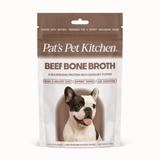
Beef Bone Broth (£24.99) provides about 40% collagen content naturally, along with minerals and other nutrients from real bone broth. It's the most palatable option, works well for picky eaters, and many dogs find it genuinely appetising rather than a "supplement".
Start with one product and give it at least 4-6 weeks consistently before deciding whether to switch. The timeline matters. Changing products too frequently makes it impossible to know which one works best for your dog.
Sources
Collagen's role in joint structure: Clark, K.L., et al. (2008). 24-Week study on the use of collagen hydrolysate as a dietary supplement in patients with osteoarthritis. Current Medical Research and Opinion, 24(5), 1485-1496.
Skin and coat health: Proksch, E., et al. (2014). Oral supplementation of specific collagen peptides has beneficial effects on human skin physiology. Nutrients, 6(1), 159-173.
Hydrolysed collagen absorption: Iwai, K., et al. (2005). Identification of food-derived collagen peptides in human blood after oral ingestion. Journal of Agricultural and Food Chemistry, 53(16), 6531-6536.
Disclaimer: This information is for educational purposes and doesn't replace veterinary advice. If your dog shows persistent stiffness, reluctance to exercise, or other signs of joint disease, consult your vet for proper diagnosis and treatment. Early intervention gives the best outcomes.
Last Updated: March 2026