"When will I see results?"
It's the first question every dog owner asks.
You've bought the collagen. You're mixing it into their food daily. But your dog still limps. Still struggles with stairs. Still moves stiffly.
You're wondering: Is this even working?
Here's the truth about how long collagen takes to work, what you should see each week, and why patience matters more than you think.
The Short Answer
Most owners notice changes around week 4.
Some dogs respond faster. Some take 6-8 weeks. A few take longer.
This isn't a painkiller. You're not masking symptoms. You're rebuilding tissue. That takes time.
Why Collagen Takes 4+ Weeks to Work
What's Actually Happening Inside Your Dog
When you give collagen, here's the process:
Day 1-3: Absorption Phase
Hydrolysed collagen peptides enter the digestive system. They're broken down further by digestive enzymes and absorbed through the intestinal wall into the bloodstream.
Studies show peak blood levels occur 1-2 hours after consumption.
Week 1-2: Distribution Phase
Those peptides travel through the bloodstream and accumulate in tissues. Research proves they concentrate significantly in cartilage, skin, and connective tissue.
But accumulation isn't the same as visible improvement. You're building up reserves.
Week 2-4: Cellular Response Phase
Collagen peptides signal cells (chondrocytes in cartilage, fibroblasts in tendons) to increase production of new collagen and other structural proteins.
This is when new tissue actually starts forming.
Week 4+: Functional Improvement Phase
Enough new tissue has formed that movement becomes noticeably more comfortable. Joints have better cushioning. Tendons and ligaments have more support.
This is when owners see the changes.
Week-by-Week Timeline: What to Expect
Week 1: The Invisible Week
What's happening: Collagen peptides are being absorbed and distributed. Blood levels rise. Tissue concentrations increase.
What you'll see: Nothing yet. Don't stop. This is the foundation.
Common mistake: Owners quit during week 1 because they don't see immediate results. You've barely started.
Week 2-3: Subtle Changes
What's happening: Cellular signalling begins. Collagen production increases at the joint level. New extracellular matrix forms.
What you might notice:
-
Slightly shinier coat (often the first visible sign)
-
Less scratching or licking (improved skin barrier)
-
Marginally easier getting up from rest (most owners miss this)
What you won't notice yet: Significant mobility improvement. It's too early.
Important: If your dog has severe arthritis or advanced joint disease, you probably won't notice anything during this period. Keep going.
Week 4-6: The Breakthrough Period
What's happening: Enough new collagen has been synthesised that structural support improves. Cartilage is thicker. Tendons are stronger. Joint capsules are more stable.
What most owners notice:
-
Easier getting up after lying down
-
More enthusiasm for walks
-
Climbing stairs with less hesitation
-
Playing more (even briefly)
-
Better overall energy
This is the critical period. Around week 4-5, most owners think: "Wait, they're actually moving better."
What affects the timeline:
-
Severity of existing damage (mild issues improve faster)
-
Age (younger dogs respond quicker)
-
Weight (lighter dogs show changes sooner)
-
Overall health
-
Consistency of supplementation
Week 6-8: Sustained Improvement
What's happening: Collagen levels have stabilised at a higher baseline. Ongoing daily supplementation maintains this new equilibrium.
What you'll see:
-
Consistent comfortable movement
-
Return to activities they'd stopped (jumping in car, playing fetch)
-
Less stiffness in the morning
-
Longer walks without tiring
This is when you know it's working.
Many owners report their dogs act "years younger" by week 8.
Month 3+: Long-Term Maintenance
What's happening: Continuous collagen supply prevents further deterioration. You're not curing the underlying problem, but you're supporting the remaining healthy tissue and slowing breakdown.
What you'll see:
-
Maintained improvements
-
Prevention of further decline
-
Better quality of life
Critical: Don't stop now. Collagen works as long as you give it. Stop supplementing, and collagen levels will drop again over 4-8 weeks.
Why Some Dogs Respond Faster Than Others
Dogs That Respond Quickly (2-4 Weeks):
Young dogs with early-stage issues
-
Less damage to repair
-
Faster cellular turnover
-
Better blood flow to joints
Dogs with mild arthritis
-
Remaining cartilage responds well to support
-
Less inflammation to overcome
Active dogs at healthy weight
-
Good muscle tone stabilises joints
-
Better circulation delivers nutrients
Dogs on high-quality diets
-
Already have some nutritional building blocks
-
Collagen fills the gap faster
Dogs That Take Longer (6-8+ Weeks):
Senior dogs (10+ years)
-
Slower cellular regeneration
-
More extensive damage
-
Multiple joint issues simultaneously
Dogs with severe arthritis
-
Extensive cartilage loss takes longer to stabilise
-
Chronic inflammation must be controlled first
Overweight dogs
-
Extra weight continues stressing joints
-
Slower metabolic processes
Dogs with poor baseline nutrition
-
Deficiencies in other nutrients slow collagen synthesis
-
Need time to build up cofactors (Vitamin C, manganese, etc.)
The 3 Factors That Speed Up Results
1. The Right Serving
Giving the correct serving for your dog's weight, every day, is what matters. More is not better, and the serving guide on the pack is there for a reason.
Daily serving guide by weight:
| Dog weight | Daily serving | Pure Collagen delivered |
|---|---|---|
| 1 to 10kg | 1 teaspoon (3g) | 3,000mg |
| 11 to 20kg | 2 teaspoons (6g) | 6,000mg |
| 21 to 30kg | 3 teaspoons (9g) | 9,000mg |
| 31kg and over | 4 teaspoons (12g) | 12,000mg |
The same serving guide applies to Mobility & Joints. Always follow the serving guide printed on the pack.
Our Pure Collagen is 100% hydrolysed collagen peptides, so every gram in the serving is collagen.
2. Consistency
Skipping days resets progress. Collagen levels in tissue drop when supplementation stops.
Daily = Results around week 4 Every other day = Results around week 8 (if at all)
Set a reminder. Make it part of your feeding routine. Don't skip.
3. Combined Approach
Collagen alone works. A complete joint formula targets more than collagen alone.
Our Mobility & Joints formula combines:
-
Collagen peptides
-
Glucosamine (cartilage support)
-
Hyaluronic acid (lubrication)
-
Vitamin C & manganese (collagen synthesis boost)
-
Vitamin E (inflammation control)
By targeting joint health from multiple angles, results appear faster and more dramatically.
Whichever product you choose, give it at the serving for your dog's weight. Never combine products to reach an amount.
View Mobility & Joints ingredients →
Signs That Collagen Is Working (Even Before Week 4)
You won't see mobility changes immediately, but these early signs indicate it's working:
Week 1-2 Early Indicators:
Coat changes:
-
Noticeably shinier
-
Softer texture
-
Less shedding
Skin improvements:
-
Less itching/scratching
-
Fewer hot spots
-
Better healing of minor cuts
Digestive signs:
-
Firmer stools (glycine in collagen supports gut lining)
-
Less gas
-
Better appetite
Nail strength:
-
Less brittle
-
Less splitting/cracking
If you see ANY of these, the collagen is being absorbed and working. Joint improvements will follow.
What If You Don't See Results After 8 Weeks?
First, ask yourself:
Are You Actually Being Consistent?
Missing 2-3 days per week cuts effectiveness in half. Check yourself honestly.
Is The Serving Right?
Giving too little is common. A 25kg dog sits in the 21 to 30kg band, which is 3 teaspoons (9g) daily, so 1 teaspoon is not the right serving for them.
Check the teaspoon serving guide printed on the pack and ensure you're giving the recommended amount for your dog's weight.
Is The Collagen Actually Hydrolysed?
Not all collagen supplements are equal. Standard collagen (non-hydrolysed) has molecules too large to absorb.
Only hydrolysed collagen peptides actually work.
Our Pure Collagen and Mobility & Joints use only hydrolysed peptides. If you're using another brand, check the label. If it doesn't say "hydrolysed" or "peptides," it won't work.
Learn why hydrolysed matters →
Is The Problem Too Severe?
If your dog has bone-on-bone arthritis with no remaining cartilage, collagen won't rebuild what isn't there.
It CAN support surrounding structures (tendons, ligaments, joint capsule) and improve comfort, but expectations need adjustment.
Consider combining with veterinary treatment (NSAIDs, joint injections) for severe cases.
Are Other Factors Undermining Results?
Weight: Every extra kilogram puts 4kg of pressure on joints. Lose the weight first.
Exercise: Too little = weak muscles, unstable joints. Too much = continued damage. Find the balance.
Diet: Poor nutrition provides no building blocks for collagen synthesis. Upgrade the food.
How to Maximise Results
Start With The Right Formula
For prevention or early issues: Pure Collagen - 100% hydrolysed collagen peptides, nothing else
For existing joint problems: Mobility & Joints - Multi-angle approach, faster functional improvement
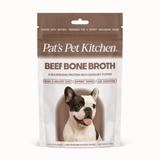
For gut health or fussy eaters: Beef Bone Broth - 40% collagen plus gelatin, great taste
Give It With Food
Collagen absorbs better when given with a meal. The digestive process is already active, enzymes are present, blood flow to the gut increases.
Morning or evening doesn't matter. With food does.
Combine With Light Exercise
Movement stimulates blood flow to joints, helping deliver collagen peptides where they're needed.
After 2-3 weeks of supplementation, gradually increase activity:
-
Longer walks
-
Gentle play
-
Swimming (exceptional for joint health)
Avoid high-impact activities until improvement is clear.
Support With Proper Nutrition
Collagen synthesis requires:
-
Vitamin C (make sure their food includes it)
-
Manganese (found in Mobility & Joints)
-
Protein (high-quality diet)
If your dog is on low-quality food, collagen supplementation will work more slowly.
Track Progress
Take videos week 1, week 4, week 8. You see your dog every day. Changes are gradual. Videos don't lie.
Compare:
-
How they get up from lying down
-
Walking gait
-
Stair climbing
-
Enthusiasm level
Progress is easier to see in retrospect.
The Bottom Line on Timeline
Week 4 is the average, not the rule.
Give it 8 weeks minimum before deciding.
Don't quit during the invisible weeks (1-3). That's when the foundation is being built.
If you're consistent with the serving, using hydrolysed collagen, and being patient, results will come.
Your dog didn't develop joint problems overnight. You can't reverse them overnight either.
But you can support them. Slow the deterioration. Improve their comfort. Give them years of better quality life.
That's worth 8 weeks of patience.
Start Now
For healthy dogs building prevention: Pure Collagen →
For dogs with existing joint issues: Mobility & Joints →
For gut health & fussy eaters: Beef Bone Broth →
Give it 8 weeks. Track the changes. Most dogs show improvement around week 4.
Last Updated: August 2026