Quick Answer: Liquid collagen and powder collagen both deliver the same active ingredient: collagen peptides. The form that matters is hydrolysed collagen, because it is broken into small peptides your dog absorbs easily. The catch with most liquids is they are mostly water, often with added sugar or preservatives, and they rarely tell you how many milligrams of collagen are in each drop, so you cannot see what you are actually getting. A pure collagen powder solves both problems: 100% collagen, a clearly stated dose, and nothing else added. Stir it into water or food and you have made your own liquid collagen, at a higher strength, for less.
You have been searching for liquid collagen for dogs. Maybe a friend mentioned it, or you saw it advertised as the easy way to support ageing joints.
The idea makes sense. A liquid sounds simple. Pour it over the food, job done.
But before you buy, it is worth understanding what you are actually paying for. Liquid is a format, not a magic ingredient. What helps your dog is the collagen itself, and the form it takes.
Here is how liquid and powder collagen really compare, what to check on the label, and the simplest way to get high-strength collagen into your dog's bowl.
What is liquid collagen for dogs?
Liquid collagen is collagen peptides suspended in water and sold ready to pour. You add it straight to your dog's food or water.
The active ingredient is the same protein found in powder: collagen, the structural building block of cartilage, skin, tendons and ligaments. As dogs age, their natural collagen production drops. Supplementing tops it back up.
The difference between liquid and powder is not the collagen. It is everything around it.
Liquid vs powder collagen: how they compare
Both formats can work. The honest answer is that powder usually gives you more for your money, because you are not paying to ship and store water.
| Liquid collagen | Hydrolysed collagen powder | |
|---|---|---|
| What is in it | Collagen plus water, often with flavourings, sugar or preservatives | Pure collagen peptides, nothing added |
| Collagen per serving | Often not stated, and lower because most of the volume is water | Clearly stated, higher and concentrated |
| Absorption | Good, if the collagen is hydrolysed | Good, hydrolysed peptides dissolve instantly |
| Value | You pay for water weight and bulky packaging | More collagen per pound spent |
| Shelf life | Shorter once opened, may need refrigeration | Long and stable in the pouch |
| Ease of use | Pour and serve | Stir a teaspoon into food or water, dissolves in seconds |
The takeaway is simple. If you want a liquid, you can make one in two seconds by stirring a quality powder into water. You just keep control of what goes in.
Does liquid collagen work better than powder?
No. The form that drives results is hydrolysed collagen, not whether it arrives wet or dry.
Hydrolysed means the collagen has been broken down into small peptides. These are easy for your dog's body to absorb and put to use in cartilage, skin and connective tissue. A hydrolysed powder dissolves completely the moment it hits water or wet food.
So a quality powder and a quality liquid, both hydrolysed, deliver collagen the same way. What separates them is concentration and the rest of the ingredient list. Many liquids carry added sugar or flavour enhancers your dog does not need. Powder lets you skip all of that.
The question most liquid collagens won't answer
Here is the test that cuts through the marketing. How many milligrams of collagen are in each drop, or in each serving?
Most liquid collagens do not say. The label shows the bottle size and lists water near the top of the ingredients, but not the actual collagen dose. If a brand will not tell you how much collagen your dog is getting, you cannot judge the value or what results to expect.
This is the real advantage of a pure powder. Pure Collagen is 100% hydrolysed collagen peptides at 6,000mg per serving. No water, no sugar, no fillers, and a dose you can actually see. That usually means more collagen per serving than a ready-made liquid, for less money, because you are not paying for a bottle of water.
What to look for, whichever format you choose
The label tells you more than the format does. Check for these four things.
Hydrolysed collagen peptides. This is the form your dog absorbs best. If the label just says "collagen" with no detail, be cautious.
A short ingredient list. Ideally collagen and nothing else. Avoid added sugar, artificial flavours and unnecessary fillers.
A stated collagen dose in mg. The label should tell you the milligrams of collagen per serving. Many liquids only show the bottle size, which hides how little collagen is actually in each drop. If the dose is not stated, assume it is low.
The source. Bovine collagen peptides are well studied and rich in Types I and III, the types that support skin, coat and connective tissue.
The simplest way to get liquid collagen into your dog
Skip the bottle of water with collagen in it. Buy the collagen, add your own water.
Pure Collagen is 100% hydrolysed bovine collagen peptides, Types I and III, at 6,000mg per serving. It is tasteless and odourless, and it dissolves instantly into water or food. Stir a teaspoon into a little warm water and you have liquid collagen, made fresh, with no sugar or preservatives and far more collagen than most ready-made liquids.
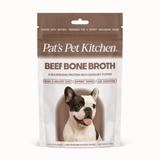
If you specifically want a savoury liquid your dog laps up, Beef Bone Broth is the natural choice. It is a collagen-rich broth that rehydrates into a warm, meaty topper, ideal for fussy eaters and dogs that need encouragement at mealtimes.
Both give you the convenience people want from liquid collagen, without paying for a bottle of water. Supplements support joint and connective tissue health. They do not cure structural problems like hip dysplasia, so see your vet for diagnosis and treatment of any existing condition.
What results to expect
Collagen is not an overnight fix. It works by giving the body the building blocks to maintain and repair connective tissue over time.
Most owners notice a pattern like this:
- Weeks 2 to 3: a softer, shinier coat is often the first visible change.
- Weeks 4 to 6: easier movement, less stiffness getting up.
- Weeks 6 to 12: more consistent comfort and willingness to move.
What collagen cannot do is reverse advanced joint disease or replace veterinary treatment. It supports the system. It does not rebuild a damaged joint overnight.
Frequently asked questions
Is liquid collagen safe for dogs?
Yes, collagen is safe and well tolerated by most dogs. The thing to watch is the extras. Some liquids contain added sugar or flavourings, so check the label and choose a clean source.
Is liquid or powder collagen better for my dog?
Neither is automatically better. Both work if the collagen is hydrolysed. Powder usually gives you more collagen per serving and a cleaner ingredient list, and you can turn it into a liquid yourself in seconds.
Can I just mix collagen powder with water?
Yes. A hydrolysed powder dissolves completely in water or wet food. That is the easiest way to make your own liquid collagen with full control over the ingredients.
How much collagen does my dog need?
It depends on their weight. Follow the serving guide on the pouch based on your dog's size, and keep it consistent day to day.
How long before I see a difference?
Coat changes often show by week 2 to 3. Mobility improvements usually build from week 4 to 6. Consistency matters more than dose, so give it daily.
My dog is fussy. Will they take it?
A tasteless, odourless powder mixes invisibly into food. If your dog needs more encouragement, a warm savoury broth topper is usually hard to resist.
Which product for your dog?
- You want liquid collagen, made fresh and filler-free: Pure Collagen, stirred into water or food.
- You want a savoury liquid your dog laps up, or you have a fussy eater: Beef Bone Broth.
- Your dog already has stiffness or a diagnosed joint issue: Mobility & Joints, a 6-in-1 blend with collagen, glucosamine and hyaluronic acid.
Follow the serving guide on your chosen product's pouch based on your dog's weight.
Sources
- Canine Arthritis Management (CAM UK), guidance on joint support and supplements, caninearthritis.co.uk
- PDSA, advice on canine joint health and mobility, pdsa.org.uk
- British Veterinary Association, guidance on responsible supplement use, bva.co.uk
Important: This information is for educational purposes and doesn't replace veterinary advice. If your dog is showing stiffness, lameness or signs of joint pain, consult your vet for proper diagnosis and treatment. Early intervention gives the best outcomes.
Last Updated: June 2026