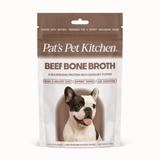
Quick Answer: Yes, bone broth is safe for puppies from around 8 weeks old. It supports hydration, gut health, and provides nutrition during the transition to solid food. Start with small amounts and watch for any digestive upset. Plain beef bone broth with no added salt, onion, or garlic is essential. Introduce it slowly and follow the serving guide based on your puppy's weight and age.
You're watching your puppy explore their food bowl. They're still figuring out solid food, and you're wondering if there's a way to make nutrition easier and more enticing.
Bone broth seems to be everywhere right now, and you've heard it mentioned for puppies. But is it actually safe? Will it help? Or is it just another trend that sounds better than it is?
Here's the straightforward answer: quality bone broth can be a genuinely useful tool when introducing puppies to solid food. It's not essential, but when used properly, it offers real nutritional benefits. This guide covers everything you need to know about introducing bone broth safely and confidently.
Is Bone Broth Safe for Puppies?
Yes. Plain, unsalted bone broth is safe for puppies from around 8 weeks old, which is roughly when most puppies start exploring solid food.
That said, safety depends on what's actually in the broth. Many commercial bone broths contain added salt, onion, or garlic, all of which are harmful to puppies. You need broth that's just bones, water, and ideally a splash of vinegar to extract minerals. Nothing else.
Beef Bone Broth is formulated specifically for dogs with no added salt, no hidden ingredients, and no harmful additions. This removes the guesswork if you're buying ready-made rather than making it yourself.
Always start with small amounts and watch for any digestive changes. Most puppies tolerate bone broth well, but introducing it gradually is the safest approach.
What Does Bone Broth Provide?
Bone broth isn't a complete meal, but it does provide real nutritional value, particularly for young puppies navigating the transition from milk to solid food.
Hydration
Puppies are curious but not always great drinkers. A puppy might only drink when they think to, and dehydration sneaks up quietly. Bone broth is mostly water, so offering it increases fluid intake in a more enticing form. Some puppies will drink broth when they won't touch plain water.
Collagen and amino acids
Beef Bone Broth contains 40% collagen, along with amino acids like glycine, proline, and glutamine. These support gut lining integrity, which is especially important for puppies whose digestive systems are still developing and learning to process solid food. Strong gut health during this early stage sets the foundation for better nutrient absorption throughout life.
Natural gelatin and minerals
Bone broth releases gelatin, which supports joint and cartilage development in growing puppies. It also contains trace minerals like calcium, magnesium, and phosphorus absorbed from the bones during the brewing process.
Appetite stimulation
Some puppies are fussy eaters early on. The flavour and aroma of bone broth can make a meal more appealing, helping them stay interested in solid food during this crucial transition period.
These benefits are nutritional support, not a substitute for a complete puppy diet. Think of it as a helpful addition to solid food, not a replacement.
When and How to Introduce Bone Broth to Puppies
Timing and approach matter. Introducing bone broth properly means your puppy gets the benefits without digestive disruption.
The right age to start
Puppies are typically ready around 8 weeks old, which is when most breeders transition them to solid food. Some puppies transition earlier or later depending on their mother's milk supply and their own appetite. There's no harm in waiting a bit longer if you're unsure. Eight weeks is the safe lower boundary, but 10 or 12 weeks is equally fine.
Start small and go slow
Your puppy's digestive system is adjusting to solid food. Add bone broth gradually so their gut has time to recognise it and adapt. Start with a teaspoon or two mixed into their regular meal, then slowly increase the amount over a week or two. This gentle approach prevents digestive upset like loose stools or nausea.
Serving options
You can serve bone broth in several ways depending on what your puppy prefers. Mix it into their existing meal to increase flavour and hydration. Offer it in a separate bowl as a drink. Pour it over dry kibble to soften it slightly and make it more enticing. Freeze it in ice cube trays for a cooling treat on warm days. Whichever method you choose, start with small amounts.
Temperature matters
Bone broth can be served at room temperature or slightly warmed, but never hot. Let any warmed broth cool completely before giving it to your puppy. Overly hot food can damage a puppy's mouth and throat.
Watch for reactions
Most puppies take to bone broth immediately. A small number might experience mild digestive upset as their gut adjusts. Loose stools are the most common sign. If you see this, slow the introduction down even more. If digestive upset persists beyond a few days, stop and speak to your vet before continuing.
Serving Amounts by Age and Size
How much bone broth your puppy should get depends on their age and size. The serving guide on the product pouch provides specific recommendations based on weight, but here's the general approach.
8 to 12 weeks old (small breeds under 10kg)
Start with 1 teaspoon per day, mixed into meals. Increase gradually to 1 to 2 tablespoons per day by the end of this period. Bone broth shouldn't replace more than 10% of their daily fluid intake; the rest should come from drinking water and their regular food.
8 to 12 weeks old (large breeds 10kg and above)
Start with 1 tablespoon per day. Increase to 2 to 3 tablespoons per day by 12 weeks. Larger puppies can tolerate more volume, but the principle remains the same: introduce gradually.
12 to 24 weeks (small breeds)
Follow the serving guide on the pouch based on your puppy's current weight. For most small breeds, this will be 2 to 4 tablespoons daily. Divide this between meals or offer it as a separate serving.
12 to 24 weeks (large breeds)
Follow the serving guide on the pouch. Large breed puppies typically get 4 to 6 tablespoons daily, though this depends on their specific weight and your vet's recommendations.
Beyond 6 months
Continue following the serving guide on the pouch based on your puppy's weight. By this age, their digestive system is well developed, and bone broth can be a regular part of their diet if you choose to include it.
These are guidelines, not rigid rules. Your puppy's individual needs depend on their breed, growth rate, overall diet, and activity level. If you're unsure, your vet can recommend a serving amount tailored to your puppy.
What to Avoid
Bone broth safety hinges on what's not in it. Some bone broths marketed for humans or general use contain additives that are dangerous for puppies.
Never give bone broth with added salt
Salt at levels safe for humans can cause serious problems in puppies. Always check labels. If sodium content is listed, avoid it. Plain broth made only from bones and water is what you need.
Never give bone broth with garlic or onion
Both are toxic to dogs of all ages. Some broths contain these as flavouring. Check the ingredient list carefully. If garlic powder, onion powder, or garlic/onion solids are listed, do not use it.
Avoid broths with artificial flavourings or additives
Puppies don't need fancy additions. If the ingredient list is longer than "bones, water, vinegar" and possibly salt-free spices, it's too complicated. Keep it simple.
Don't use bone broth with cooked bones
Raw or simmered bones that have been boiled down for broth are safe. Cooked bones that your puppy could ingest whole are not. (This is about whole bones in a broth, not the broth itself from cooked bones.)
Avoid broths claiming to be "nutrient-dense" without ingredient verification
Marketing claims like "supercharged" or "enhanced" often mean added ingredients you can't see from the label. Look for simple, transparent labelling.
Beef Bone Broth contains just what your puppy needs: beef bone broth with 40% natural collagen, no salt, no hidden additives. This removes the safety guesswork.
Homemade vs Ready-Made Broth
You can make bone broth at home or buy it ready-made. Both approaches work if done correctly.
Homemade bone broth
Making your own gives you complete control over ingredients. Use beef bones (knuckle bones or marrow bones are ideal), cover with water, add a splash of apple cider vinegar to help extract minerals, and simmer for 12 to 24 hours. Strain thoroughly, cool, and store in the fridge for up to 5 days or freeze for longer.
The advantage is transparency. You know exactly what's in it. The disadvantage is time and effort. You'll also need to calculate portions carefully to match your puppy's needs, which is less exact than a commercial product with serving guides.
Ready-made bone broth
Quality brands eliminate prep work and guesswork. A dog-specific broth like Beef Bone Broth is formulated and tested to be safe for puppies, with clear serving guides by weight. The convenience and safety certainty are worth the cost for most puppy owners.
If you buy ready-made, check labels carefully. Ensure there's no added salt, no garlic or onion, and no mysterious additives. Human-grade bone broth for cooking is often salted and not suitable for puppies.
Neither approach is inherently better. Choose based on your time, budget, and confidence in reading ingredient labels.
Bone Broth and Transitioning to Solid Food
Bone broth plays a useful role during the weaning transition, which typically happens between 6 and 12 weeks of age.
At 6 weeks, puppies are still nursing or bottle-fed. By 8 weeks, most are eating soft solid food and drinking water. By 12 weeks, they're eating regular puppy kibble alongside water and other foods. This transition is gradual, and each puppy moves at their own pace.
Bone broth bridges this transition. It's easier to swallow and digest than dry kibble, so it helps puppies stay interested in eating while their mouth and digestive system adjust. It provides hydration without relying entirely on water from the bowl. It offers nutrition during a period of rapid growth when every calorie counts.
You might mix bone broth into soft puppy food initially, then gradually reduce the ratio as your puppy becomes more confident with solid food. By 16 to 20 weeks, most puppies can transition entirely to regular kibble with water, though you can continue offering bone broth if your puppy enjoys it.
Think of it as scaffolding for the transition, not a permanent necessity. It's there when it helps, and you gradually remove it as your puppy needs it less.
Frequently Asked Questions
Can newborn puppies (under 8 weeks) have bone broth?
Puppies under 8 weeks are still nursing or bottle-feeding. Their digestive systems aren't ready for broth. Wait until around 8 weeks when they're starting solid food. If a very young puppy is orphaned or hand-reared, your vet will advise on when to introduce solid foods.
Will bone broth help my puppy's digestion?
Bone broth supports gut health through its collagen and amino acid content, which strengthen the gut lining. However, it's not a treatment for digestive issues. If your puppy has persistent diarrhoea, constipation, or vomiting, see your vet. Bone broth complements good nutrition but doesn't fix underlying problems.
Can I give bone broth every day?
Yes, you can offer bone broth daily if you want to. Follow the serving guide based on your puppy's weight. It becomes part of their regular diet rather than an occasional treat. Some owners do this; others save it for meals when they want to boost their puppy's interest in eating.
How long can I store homemade bone broth?
Homemade bone broth stays fresh in the fridge for 3 to 5 days. Freeze it in ice cube trays for longer storage, up to 3 months in the freezer. Thaw overnight in the fridge before serving. Ready-made broth will have shelf-life instructions on the packaging; follow those.
What if my puppy doesn't like bone broth?
Not all puppies are enthusiastic about it. Some prefer the texture of their regular food. This is fine. Bone broth is beneficial but not essential. If your puppy isn't interested, don't force it. They're getting nutrients from their regular puppy diet.
Is bone broth enough on its own as a meal?
No. Bone broth alone doesn't provide complete nutrition for a growing puppy. It's a supplement to or component of meals, not a replacement for complete puppy food. Puppies need protein, fats, vitamins, minerals, and other nutrients that bone broth alone can't supply. Always feed bone broth alongside a balanced puppy diet.
Will bone broth help my puppy's joints?
The collagen and gelatin in bone broth support joint and cartilage development in growing puppies. This is beneficial for all puppies, and particularly useful for large and giant breeds that are prone to joint issues later in life. Start bone broth early and continue it through the growth period for best results.
Which Product for Your Puppy?
- Puppies from 8 weeks old, transitioning to solid food, or needing hydration and gut support: Beef Bone Broth
- Growing puppies (especially large/giant breeds) needing joint support and general nutrition: Beef Bone Broth or Pure Collagen
- Puppies with joint concerns or comprehensive joint support for future health: Mobility & Joints
Follow the serving guide on your chosen product's pouch based on your puppy's current weight.
Sources
- PDSA. Puppy nutrition and weaning guidance. pdsa.org.uk
- The Kennel Club. Puppy care and feeding recommendations. thekennelclub.org.uk
- VCA Animal Hospitals. Puppy nutrition and dietary needs. vcahospitals.com
- British Veterinary Association. Puppy health and nutrition advice. bva.co.uk
- Swanson KS, et al. Nutritional requirements of dogs and cats. Journal of the American Veterinary Medical Association. 2011
Important: This information is for educational purposes and doesn't replace veterinary advice. If your puppy shows signs of digestive upset, allergic reactions, or has existing health conditions, consult your vet before introducing bone broth or any new food. Always discuss nutritional changes with your veterinarian, especially for large breed puppies prone to joint or growth-related issues. Early intervention gives the best outcomes.
Last Updated: March 2026