Quick Answer: Hyaluronic acid is a natural compound that lubricates joints and keeps cartilage hydrated. It declines with age, leading to stiffness and wear. Oral hyaluronic acid supplements support joint fluid quality and work alongside collagen and glucosamine. Pair it with other joint support ingredients rather than using it on its own. Mobility & Joints combines HA with collagen and glucosamine for comprehensive joint support.
Your dog used to leap onto the sofa without thinking. Now they stand at the edge, looking up at you. Waiting to be lifted.
You might have noticed it creeping in. Getting up takes longer. They're stiffer in the mornings. The joy-jump when you reach for the lead has faded to a quiet wag.
You've heard about collagen and glucosamine. But you've also seen "hyaluronic acid" on supplement bottles, and you're wondering what it actually does. Is it another marketing term? Or does your dog's aging joints really need it?
Hyaluronic acid isn't hype. It's a real compound doing real work inside your dog's joints right now. This guide explains what it is, why it matters, how it works, and whether it belongs in your dog's supplement routine.
What Is Hyaluronic Acid?
Hyaluronic acid (HA) is a naturally occurring substance found throughout your dog's body. It's a polysaccharide, a long chain of sugar molecules, but that technical name doesn't capture what it actually does.
Think of hyaluronic acid as a moisture magnet and lubricant combined. A single molecule of HA can bind up to 1,000 times its weight in water. In joints, this hydration matters enormously. It plumps up the cartilage, keeping it spongy and resilient. It thickens the synovial fluid, the slippery liquid inside the joint capsule that allows bones to glide smoothly against each other without friction.
Without adequate hyaluronic acid, synovial fluid becomes thinner and less protective. Cartilage dries out. Friction increases. Wear accelerates. Stiffness follows.
Where Hyaluronic Acid Is Found
Your dog's body manufactures hyaluronic acid naturally in connective tissue, cartilage, and synovial fluid. It's not something they need to consume to have at all. It's endogenous, meaning the body produces it.
But production declines with age. A young dog's body keeps joints well-hydrated and well-lubricated. By the time your dog reaches 7 or 8 years old, HA production drops. Synovial fluid becomes less viscous. Cartilage loses hydration. The protective cushioning weakens.
This isn't a deficiency disease. It's the normal wear and tear of aging joints. But it's also where supplementation can help.
Hyaluronic Acid and Synovial Fluid
Synovial fluid is the star player here. It's a thick, slippery liquid that fills the joint capsule and keeps bones from grinding together. Imagine the difference between moving a door hinge that's been oiled versus one that's dry and squeaky.
Hyaluronic acid is one of the key ingredients in synovial fluid. A healthy joint contains high concentrations of HA. This keeps the fluid viscous enough to absorb shock, cushion movement, and reduce friction. It also delivers nutrients to the cartilage and removes waste products.
When HA levels drop, the fluid becomes thinner. It loses its shock-absorbing capacity. Cartilage receives less nutrition. Friction increases. Stiffness and discomfort follow.
This is why veterinary research focuses on maintaining synovial fluid quality as part of joint health. Hyaluronic acid supplementation helps restore that viscosity and protective function.
How Hyaluronic Acid Declines with Age
Your dog's body can't keep up with the demand. HA is constantly being broken down and reabsorbed in joints. In young dogs, new HA is synthesized faster than it's degraded. The balance favours hydration and viscosity.
Around age 7 or 8, synthesis slows. Degradation continues. The balance tips the other way. Synovial fluid becomes less protective. Cartilage hydration drops. Movement becomes less fluid.
This decline is accelerated by factors like joint overuse, obesity, previous injury, and arthritis. A dog that's carried excess weight for years or had high-impact activity (like repeated jumping or agility work) often shows joint changes earlier than age alone would predict.
This is why hyaluronic acid supplementation makes most sense for senior dogs or those with existing joint concerns. Younger, healthy dogs aren't losing HA yet, so the need is lower.
Oral vs Injectable Hyaluronic Acid
You might encounter both forms in your research. Understanding the difference helps you make the right choice for your dog.
Injectable HA is administered directly into the joint by a veterinarian. It reaches the synovial fluid immediately and provides rapid relief. It's used for dogs with diagnosed joint disease and is prescribed by a vet. Injections work quickly but require professional administration.
Oral HA is taken by mouth as a supplement. It has to survive the digestive system and be absorbed into the bloodstream, then accumulate in joint tissues. This process is slower and less direct than injection. However, oral supplementation works continuously and can be maintained long-term without veterinary procedures.
The key question: does oral HA actually reach the joints? Research suggests yes, but the amount that accumulates is lower than with injections. Studies using hydrolysed HA show that some molecules are absorbed intact and do accumulate in cartilage tissue. The effect is more subtle than injection but real.
Oral HA works best when paired with other joint-support ingredients like collagen and glucosamine, which work through complementary mechanisms. It's part of a comprehensive approach, not a standalone solution.
For most owners, oral supplementation is the practical choice. For dogs with acute joint pain or diagnosed osteoarthritis, your vet might recommend injections as part of the treatment plan. The two approaches aren't mutually exclusive.
Hyaluronic Acid and Collagen: How They Work Together
Hyaluronic acid alone is incomplete. It maintains hydration and synovial fluid quality, but it doesn't provide the structural rebuilding blocks that cartilage needs.
Collagen is the protein scaffold. It gives cartilage its shape and tensile strength. When cartilage breaks down, collagen degrades along with it. Supplementing with hydrolysed collagen peptides provides amino acids that accumulate in cartilage and support repair and maintenance.
Together, they do different jobs. Collagen provides structure and rebuilding materials. Hyaluronic acid maintains hydration and lubrication. A supplement containing both addresses multiple aspects of joint health. This is why Mobility & Joints, which combines 5,000mg collagen peptides with hyaluronic acid, works more effectively than either ingredient alone.
Hyaluronic Acid and Glucosamine
Glucosamine is another partner ingredient. It's an amino sugar that supports cartilage structure and helps maintain the cartilage matrix that holds water and collagen in place.
Glucosamine doesn't directly add HA to joints. But it supports the cartilage tissue that holds HA and water. Together with collagen and HA, it creates an environment where joint tissue is better hydrated, more resilient, and slower to degrade.
The three-ingredient combination (collagen, glucosamine, hyaluronic acid) is common in joint supplements because they work synergistically. Each supports a different aspect of joint health. Mobility & Joints includes all three, plus manganese and vitamins C and E, which support collagen synthesis and reduce joint inflammation.
What the Research Shows in Dogs
Most joint supplement claims lean on human studies. The canine evidence is smaller, but it is growing, and two findings are worth knowing.
On collagen, a 2024 placebo-controlled, double-blind trial in dogs with osteoarthritis measured movement objectively using a force plate. The dogs given hydrolysed collagen peptides showed significant improvement in how they loaded their affected legs, alongside better owner-reported quality of life. The placebo group got worse over the same twelve weeks. Collagen is the workhorse of a good joint formula, and this is the kind of study that shows why.
On hyaluronic acid, the practical question has always been whether an oral dose actually reaches the joint or simply gets broken down in digestion. A randomised, double-blind trial in dogs recovering from cruciate surgery found that dogs given oral HA had a measurable rise in hyaluronic acid inside the joint fluid itself. Oral HA does reach the target tissue.
Each ingredient addresses a different part of the joint, which is why Mobility & Joints combines them rather than relying on any one alone.
What to Look For in a Hyaluronic Acid Supplement
Complementary ingredients: HA works best with collagen and glucosamine. A supplement containing all three addresses joint health from multiple angles. Single-ingredient HA supplements are less effective than combination formulas.
Additional joint support: Look for manganese, which supports collagen synthesis. Vitamin C, which is required for collagen formation. Vitamin E, which reduces inflammation. Mobility & Joints includes all of these alongside the core three ingredients.
Verified sourcing: Hyaluronic acid in supplements typically comes from rooster combs or fermented plant sources. Knowing the source matters because it affects purity and allergenic potential. PPK's Mobility & Joints contains HA from verified sources and is made in England with human-grade ingredients.
Sensible formulation: In dogs, hyaluronic acid works as a supporting ingredient, not a standalone fix. What matters is whether it sits inside a complete joint formula alongside collagen and glucosamine, which do the structural work. A big dose of HA on its own, without those, is the weaker choice.
No artificial additives: Your dog doesn't need flavourings, colours, or fillers. Clean ingredients matter. PPK products contain no artificial additives.
How Hyaluronic Acid Supplements Work: The Timeline
Unlike injectable HA, which provides rapid pain relief, oral hyaluronic acid works gradually. The timeline for noticing improvement typically looks like this:
Week 1-2: No obvious change. The supplement is being absorbed and distributed. Your dog is receiving the ingredients, but structural changes haven't started yet.
Week 2-4: Possible early improvements in coat and skin. Joint changes are still subtle. Consistency matters at this stage. Many owners discontinue too early.
Week 4-6: Most dogs show noticeable improvement. Stiffness decreases, especially after rest. Getting up is easier. Movement looks freer. This is when owners often feel the investment is paying off.
Week 8-12: Continued improvement. Muscle tone in the hips and rear legs may improve as your dog moves more freely and is willing to be more active.
Timeline varies. Age, severity of existing joint issues, weight, and overall health all influence how quickly your dog responds. Consistency matters more than speed. Dogs see better results when supplementation is continuous rather than intermittent.
Who Needs Hyaluronic Acid Supplementation
Senior dogs (7+ years old) with stiffness or reduced mobility benefit most. HA production has already declined, and supplementation helps restore synovial fluid quality.
Dogs with diagnosed joint conditions like hip dysplasia, elbow dysplasia, or osteoarthritis need synovial fluid support. HA is part of comprehensive management.
High-activity dogs that have spent years in sport or high-impact activity (agility, jumping, herding) often develop joint wear. Supplementation supports recovery and ongoing health.
Larger breed dogs are at higher risk for joint issues due to their body weight and growth rate. Starting supplementation earlier, around age 5-6, can be preventative.
Dogs recovering from joint surgery benefit from HA supplementation, particularly if approved by your vet for timing. It supports the healing environment and reduces inflammation.
Younger, healthy dogs don't need HA supplementation yet. Their bodies are still producing adequate amounts. Prevention-focused supplementation with collagen alone is a more appropriate choice at this age.
Hyaluronic Acid and Exercise: Finding the Balance
A common question: will movement damage aging joints further? The answer is nuanced. Movement is essential. Without it, muscle atrophies, joints stiffen further, and mobility declines faster.
The key is appropriate movement. High-impact activity like jumping or sharp turns stresses dysplastic joints. Gentle, regular movement supports joint health by promoting circulation, maintaining muscle tone, and keeping joints mobile.
Walking on soft ground (grass, sand) is ideal. Swimming or hydrotherapy is excellent if available. Avoid hard surfaces like concrete for extended periods. Keep sessions regular and moderate. Stop before your dog shows signs of pain or limping.
Hyaluronic acid supplementation supports this balanced activity. It improves synovial fluid quality so that gentle movement is easier and less painful. This allows your dog to be more active without discomfort, which in turn maintains muscle and mobility.
Hyaluronic Acid vs Cortisone and NSAIDs
You might hear about these other joint management options. Understanding how they differ helps you make informed decisions with your vet.
Cortisone reduces inflammation quickly and can provide immediate pain relief. But it's not designed for long-term use. Regular cortisone injections can accelerate cartilage breakdown over time. It's used for acute flare-ups, not ongoing management.
NSAIDs (non-steroidal anti-inflammatories like carprofen) reduce pain and inflammation. They work quickly and effectively. They're appropriate for diagnosed joint conditions. But they're medication, not structural support. They manage symptoms while the joint continues to degrade.
Hyaluronic acid and collagen supplements don't provide immediate pain relief like NSAIDs do. But they address the underlying joint health. They work to slow degradation and support tissue. They're preventative and supportive, not acutely therapeutic.
These aren't competing options. Your vet might recommend NSAIDs for acute pain while simultaneously recommending supplements for structural support. Many dogs benefit from both approaches.
Frequently Asked Questions
Is hyaluronic acid the same as collagen? No. Collagen is a structural protein. Hyaluronic acid is a hydrating compound. They do different jobs in the joint. Collagen provides the framework. HA maintains hydration and lubrication. The best joint supplements include both.
Can I give my young dog hyaluronic acid for prevention? It's not necessary. Young dogs are still producing adequate HA. Prevention-focused supplementation with collagen alone is more appropriate and cost-effective. Start HA supplementation around age 6-7 or if your dog shows early signs of stiffness.
How long does a dog need to take hyaluronic acid? For ongoing joint health, ideally indefinitely. HA production doesn't restart. Supplementation supports declining production. If you stop, the benefit fades. Think of it like ongoing joint maintenance, not a course of treatment with an end date.
Does hyaluronic acid work for all dogs? Most dogs benefit, but individual response varies. Dogs with severe joint damage may need additional intervention like injections or medication. Dogs with mild stiffness often respond well to oral supplementation. Your vet can assess whether supplementation is appropriate and sufficient for your dog's situation.
Can hyaluronic acid replace pain medication? Not if your dog has significant pain. Supplements support joint health but don't provide the acute pain relief that NSAIDs do. If your dog is limping or showing signs of discomfort, see your vet first. Supplements can work alongside medication, not instead of it.
Why is collagen with hyaluronic acid better than hyaluronic acid alone? Because they address different aspects of joint health. HA maintains hydration and fluid quality. Collagen provides structural support. Together, they work synergistically. Studies on joint health support combination approaches over single ingredients.
How do I know if my dog's joints are improving? Watch for practical changes: easier movement after rest, less reluctance to walk or climb stairs, faster recovery after activity, less visible stiffness in the morning. These are clearer indicators than any supplement marketing claim. Improvement takes weeks, not days.
Is there a risk to giving hyaluronic acid? Hyaluronic acid supplements are very safe. Side effects are rare and mild when they occur. Allergic reaction is possible but uncommon. Start any new supplement and watch for digestive upset. If your dog has an existing condition, mention supplementation to your vet, though interactions are unlikely.
Which Product for Your Dog?
- Senior dog with stiffness or diagnosed joint condition: Mobility & Joints (£34.99) combines 5,000mg collagen with hyaluronic acid, glucosamine, manganese, vitamin C, and vitamin E. This comprehensive formula addresses all aspects of joint health and is ideal when your dog needs structural support alongside synovial fluid maintenance.
- Healthy dog for prevention, or younger dog without joint concerns: Pure Collagen (£31.99) at 6,000mg per serving provides robust structural support without the added HA. HA supplementation becomes relevant as dogs age or if joint issues develop.
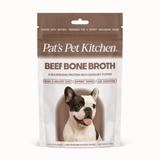
- Dog that won't eat powders, or needs appetite support alongside joint care: Beef Bone Broth (£24.99) contains 40% natural collagen and includes gelatin that supports joint health. Broth can be mixed with food to encourage eating in fussy eaters or dogs with reduced appetite.
Follow the serving guide on your chosen product's pouch based on your dog's weight. Consistency matters more than occasional use. Dogs show better results with continuous supplementation.
Sources
- Dobenecker, B., Böswald, L. F., Reese, S., et al. (2024). "The oral intake of specific Bioactive Collagen Peptides (BCP) improves gait and quality of life in canine osteoarthritis patients." PLoS ONE, 19(9), e0308378.
- Serra Aguado, C. I., Ramos-Plá, J. J., Soler, C., et al. (2021). "Effects of Oral Hyaluronic Acid Administration in Dogs Following Tibial Tuberosity Advancement Surgery for Cranial Cruciate Ligament Injury." Animals, 11(5), 1264.
- British Small Animal Veterinary Association. Canine joint health and supplement guidelines.
- Canine Arthritis Management UK. Evidence-based management and supplementation for aging joints.
- PDSA Pet Health Information. Joint health in senior dogs.
Disclaimer: This information is for educational purposes and doesn't replace veterinary advice. If your dog shows signs of joint pain, stiffness, or limping, consult your vet for proper diagnosis and treatment. Supplements support joint health alongside veterinary care but don't treat, cure, or replace professional treatment. Always consult your vet before starting any supplement, especially if your dog is on medication.
Last Updated: July 2026