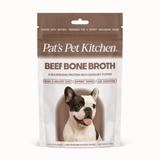
Quick Answer: Bone broth and collagen supplements both support joint health, but they work differently. Bone broth is a whole-food source with 40% collagen plus amino acids, gelatin, and minerals, making it ideal for fussy eaters and gut health. Collagen supplements deliver concentrated hydrolysed peptides (up to 6,000mg per serving) for targeted structural support. For most dogs, choose one based on your dog's needs and what they'll actually consume. Some dogs benefit from both.
You're standing in the pet supplement aisle (or scrolling online) and you've narrowed it down to two options. Both promise joint health. Both contain collagen. But one looks like food and the other looks like powder.
The question feels important, but it's also confusing. Are they the same thing? Is one better? Do you need both?
The honest answer is this: they're different tools for the same job. Which one works best depends entirely on your dog.
What Is Bone Broth?
Bone broth is made by slow-cooking animal bones (in our case, beef) with water for 12 to 24 hours. This extended cooking breaks down the bone structure, releasing collagen, gelatin, amino acids, and trace minerals into the liquid.
It's essentially food, not a supplement. It's the same thing you might make at home if you had the time and patience.
Beef Bone Broth contains 40% collagen by weight, but that collagen isn't isolated or broken down further. It's part of a whole package that also includes gelatin (which becomes collagen when hydrolysed in the dog's digestive system), amino acids like glycine and proline, and minerals like calcium and phosphorus.
What makes bone broth different from a collagen powder is the form. It's a liquid or gel that smells and tastes like food. Dogs recognise it as food. This matters more than you might think.
What Is Collagen Supplement?
Collagen supplement is processed differently. Raw collagen from bone or connective tissue is hydrolysed, which means it's broken down into smaller peptide chains. This happens in a laboratory using enzymatic processes.
The result is a fine powder containing hydrolysed collagen peptides. The peptides are already partially broken down, making them small and stable enough to dissolve in water or mix into food without changing texture or taste.
Pure Collagen provides 6,000mg of 100% hydrolysed bovine collagen peptides (Types I and III) per serving. Mobility & Joints combines 5,000mg of hydrolysed collagen with glucosamine, hyaluronic acid, and supporting vitamins.
Collagen supplements are concentrated. You're getting a specific dose of collagen in a small volume, without the whole-food elements that come with bone broth.
How They Work Differently in Your Dog's Body
This is where the real difference becomes clear.
Bone broth enters the digestive system as food. Your dog's stomach acid and enzymes break down the gelatin and collagen further, releasing amino acids that the body absorbs and uses to support joint cartilage, connective tissue, and gut lining. It's a slower, gentler process. The whole-food matrix (minerals, amino acid ratios, gelatin structure) works together.
Because bone broth is food, it also provides hydration and supports digestive health. Dogs that struggle with gut issues or have low appetite often benefit from the easy-to-digest, nutrient-dense nature of broth.
Collagen supplement skips the early breakdown steps. The peptides are already hydrolysed, so they're absorbed more directly and efficiently. Research shows that hydrolysed collagen peptides accumulate in cartilage and connective tissue after oral supplementation, suggesting targeted support for structural tissues.
The concentrated dose means you're delivering more collagen peptides per serving with less volume. This is an advantage if you need high doses or if your dog won't eat a whole-food supplement.
Collagen supplements are neutral in taste and smell, so they work well for dogs that reject stronger-flavoured foods.
Bone Broth vs Collagen: Key Differences
| Factor | Bone Broth | Collagen Supplement |
|---|---|---|
| Collagen content | 40% (whole-food form) | 100% hydrolysed peptides (up to 6,000mg) |
| Form | Liquid or gel; recognisable as food | Powder; mixed into food or water |
| Taste and smell | Strong meaty flavour; attracts most dogs | Tasteless and odourless |
| Added nutrients | Gelatin, amino acids, minerals (Ca, P) | Only collagen (or + glucosamine/HA in M&J) |
| Dose concentration | Lower per serving; whole-food dilution | Highly concentrated; higher per serving |
| Absorption speed | Slower (via normal digestion) | Faster (pre-hydrolysed peptides) |
| Best for | Fussy eaters, appetite support, gut health, puppies | Dogs with existing issues, prevention, picky eaters who reject flavour |
| Price (typical) | £24.99 | £31.99 (Pure) or £34.99 (Mobility & Joints) |
Which One Should You Choose?
Choose bone broth if:
- Your dog is a fussy eater and you need something with strong palatability (meaty flavour and smell)
- Your dog has low appetite or poor digestion and needs the extra hydration and digestive support
- Your dog is a puppy (from around 8 weeks) and you're starting joint support early
- Your dog is recovering from illness and needs nutrient-dense, easy-to-digest support
- You want a whole-food supplement with multiple nutrient benefits beyond collagen
Choose collagen supplement if:
- Your dog has diagnosed joint issues or existing stiffness and needs concentrated collagen support
- Your dog rejects strong flavours or you prefer a neutral-tasting product
- You need a higher dose of collagen in a smaller volume
- Your dog is healthy and you're focusing on prevention and maintenance
- You want to target collagen support without additional nutrients (Pure Collagen) or combined with joint-specific support (Mobility & Joints)
Both work. The question isn't which is objectively better, but which matches your dog and your situation.
Can You Use Both Together?
Yes, and sometimes it makes sense.
Stacking bone broth and collagen supplement isn't necessary for most dogs. A single product usually provides adequate support. But there are situations where both together create a benefit your dog wouldn't get from one alone.
Stacking makes sense if:
- Your dog is large breed with high joint demands (more collagen needed than a single product can provide)
- Your dog has both joint issues AND poor appetite (broth for palatability and nutrition, collagen for joint support)
- Your dog is post-surgery and benefits from the hydration and nutrient density of broth plus the concentrated collagen support of a powder
- Your dog is a senior with multiple concerns where whole-food and supplement approaches complement each other
Stacking does not make sense if:
- Your dog has no particular needs beyond general joint support
- Cost is a factor and you're looking to keep supplementation simple
- Your dog eats one product well and the other sits ignored
Follow serving guides on the pouch for both products based on your dog's weight. There's no conflict between bone broth and collagen supplements. Your dog's body will use what it needs.
What Results to Expect
Both bone broth and collagen supplements work by supporting structural tissues. But neither is a quick fix.
Timeline for bone broth:
- Week 1-2: Improved appetite and hydration (most visible change)
- Week 2-4: Possible improvement in coat and skin
- Week 4-6: Gradual increase in mobility and comfort
- Week 6-12: More noticeable improvements in stiffness and flexibility
Timeline for collagen supplement:
- Week 2-3: Possible coat or skin improvements
- Week 4-6: Reduced stiffness, improved mobility
- Week 6-12: More noticeable joint comfort and movement
Individual dogs vary. Some show visible changes in 3 weeks. Others take 8 to 12 weeks. Consistency matters more than speed. Supplements work best when used regularly over time.
What collagen cannot do: Supplements support joint health and provide building blocks for tissue repair. They don't cure hip dysplasia, osteoarthritis, or other diagnosed conditions. They work alongside veterinary care, not instead of it.
Frequently Asked Questions
Is bone broth really a supplement, or is it just food?
It's both. Bone broth is food in form and digestion, but it's intentionally crafted to be nutrient-dense. When you're using it specifically for joint, gut, or skin support, it functions as a supplement. The line between food and supplement gets blurry with bone broth, and that's actually one of its strengths.
Why is collagen supplement more expensive than bone broth?
The hydrolysation process is expensive. Breaking collagen down into peptides requires enzymatic processing, filtering, and drying. You're paying for the processing and the concentrated dose. Bone broth is simmered, then packaged. Simpler process, lower cost.
Can puppies have collagen supplement, or should I use bone broth?
Both are safe for puppies. Bone broth is gentler and more traditionally used for young dogs (from about 8 weeks). Pure Collagen and Mobility & Joints are also appropriate for puppies, but follow the serving guide based on your puppy's weight. Bone broth is often preferred because it's a whole food and provides additional digestive support during growth.
My dog won't eat bone broth. Should I force it or switch to powder?
Don't force it. If your dog rejects broth, switch to collagen supplement. Some dogs genuinely dislike strong flavours. Collagen powder is tasteless and mixes into any meal without changing the food your dog actually likes. A supplement your dog won't eat doesn't help anyone.
Which one works faster?
Collagen supplement is absorbed more quickly because it's pre-hydrolysed. But "faster" in supplement terms usually means a difference of 1 to 2 weeks across a 6 to 12 week timeline. This isn't usually the deciding factor. Choose based on what your dog will eat and what your situation requires.
Can I use bone broth to hydrate dry food instead of water?
Yes, absolutely. This is a practical way to include bone broth without adding another "supplement" step. Pour warm broth over dry kibble instead of water. Your dog gets the nutrient benefit, and you don't need to remember an extra feeding routine.
Do I need to consult my vet before starting either one?
It's always good practice to mention supplements at your next vet visit, especially if your dog is on medication or has a diagnosed condition. Both bone broth and collagen are food-based and very safe, but your vet may have specific timing recommendations (particularly post-surgery or with certain medications).
Which Product for Your Dog?
- Fussy eater, poor appetite, puppy, or general gut support: Beef Bone Broth
- Healthy adult dog, prevention and maintenance: Pure Collagen
- Dog with existing joint issues or stiffness: Mobility & Joints
- Large breed, high joint demands, or multiple concerns: Combination of Beef Bone Broth and Pure Collagen
Follow the serving guide on your chosen product's pouch based on your dog's weight.
The Honest Comparison
Bone broth is whole-food collagen support. It's gentle, nutrient-dense, and excellent for dogs that need appetite stimulation or digestive support alongside joint care. It's what your dog's ancestors would have eaten.
Collagen supplement is concentrated, processed support. It delivers a precise dose of hydrolysed peptides designed for efficient absorption and targeted tissue support. It's what modern supplement science provides.
One isn't better. They're different tools. Your job is to pick the one that matches your dog's needs, temperament, and your schedule.
If your dog is a reluctant eater, picks bone broth. If your dog needs serious joint support and rejects flavoured foods, picks collagen. If your dog is healthy and you want whole-food nutrition, picks broth. If you're focused purely on prevention in a food-motivated dog, collagen works.
The best supplement is the one your dog will actually consume consistently. Start there, and you've already made the right choice.
Sources
- König D, Oesser S, Scharla S, Zdzieblik D, Gollhofer A. Specific Collagen Peptides Improve Bone Mineral Density and Bone Markers in Postmenopausal Women. Nutrients. 2018.
- Schunck M, Oesser S, Zdzieblik D. The effect of daily consumption of specific bioactive collagen peptides on skin elasticity, hydration, and wrinkles. Journal of Cosmetic Dermatology. 2015.
- Moskowitz RW. Role of collagen hydrolysate in bone and joint disease. Seminars in Arthritis and Rheumatism. 2000.
- Lugo JP, Saiyed ZM, Lau FC, et al. Efficacy and tolerability of an undenatured type II collagen supplement in modulating knee pain: a multicenter randomized, double-blind, placebo-controlled study. Nutrition Journal. 2016.
- British Veterinary Association. Nutritional support for joint health in dogs. bva.co.uk
- PDSA Pet Health Information. Feeding supplements and joint health. pdsa.org.uk
Disclaimer: This information is for educational purposes and doesn't replace veterinary advice. If your dog shows signs of joint problems, limps, or has difficulty moving, consult your vet for proper diagnosis and treatment. Supplements support joint health but don't treat, cure, or replace veterinary care. Early intervention gives the best outcomes.
Last Updated: March 2026