Your 7-year-old dog doesn't bounce back like they used to.
Recovery takes longer. Their coat doesn't shine. They're stiff after rest. Small injuries take weeks to heal instead of days.
This isn't just "getting old." This is collagen decline.
Here's what's happening inside your dog's body, and why it matters.
What is Collagen Production?
Your dog's body constantly makes new collagen.
Think of it like a construction site that never closes. Every single day, your dog's cells are:
-
Building new collagen molecules
-
Breaking down old, damaged collagen
-
Replacing worn-out structural proteins
In a young, healthy dog:
-
Production = Breakdown
-
The balance is maintained
-
Tissues stay strong and healthy
As dogs age:
-
Production < Breakdown
-
The balance tips negative
-
Tissues gradually weaken
The collagen account is overdrawn.
Where Collagen Production Happens
Collagen isn't made in one place. It's produced throughout the body.
Primary production sites:
1. Fibroblasts (in connective tissue)
-
Most important collagen-producing cells
-
Found in skin, tendons, ligaments, fascia
-
Produce Types I and III collagen
2. Chondrocytes (in cartilage)
-
Specialized cells in joint cartilage
-
Produce Type II collagen
-
Critical for joint health
3. Osteoblasts (in bones)
-
Bone-building cells
-
Produce Type I collagen for bone matrix
-
Provide structural framework for calcium deposition
4. Other specialized cells
-
Gut lining cells
-
Blood vessel cells
-
Organ tissue cells
The process:
Step 1: DNA instruction Genes tell cells: "Make collagen"
Step 2: Protein synthesis Cells assemble amino acids into collagen chains (requires vitamin C)
Step 3: Triple helix formation Three collagen chains wind together into a triple helix
Step 4: Secretion Completed collagen molecule is released outside the cell
Step 5: Cross-linking Collagen molecules bind together to form strong fibers
The Peak Years: When Production is Highest
Puppy to young adult (0-2 years):
This is the building phase.
-
Collagen production is at maximum capacity
-
Growth requires massive amounts of new collagen
-
Bones, muscles, tendons, skin all developing rapidly
-
Production far exceeds breakdown
Signs of peak production:
-
Fast wound healing (cuts heal in days)
-
High energy and stamina
-
Flexible, pain-free movement
-
Shiny, elastic skin
-
Thick, lustrous coat
-
Strong nails
Prime adult years (2-5 years):
This is the maintenance phase.
-
Production equals breakdown
-
Tissues are maintained at optimal health
-
Peak physical performance
-
Fastest recovery from exercise or injury
When Decline Begins
The drop seems small year-to-year. But it's cumulative and irreversible.
By the time a dog reaches double figures, they are typically producing noticeably less collagen than they did in their prime.
Why decline starts:
1. Cellular aging
-
Fibroblasts become less efficient
-
Slower protein synthesis
-
More errors in collagen assembly
2. Hormonal changes
-
Growth hormone declines
-
IGF-1 (insulin-like growth factor) reduces
-
These hormones stimulate collagen production
3. Oxidative stress
-
Years of accumulated free radical damage
-
Damages cellular machinery needed for collagen production
4. Mitochondrial decline
-
Mitochondria (cellular energy factories) become less efficient
-
Less energy available for protein synthesis
The Cascade Effect: What Happens When Production Drops
Collagen decline doesn't affect just one thing. It affects everything.
Joints (First to Show Symptoms)
What happens:
-
Cartilage thins (less Type II collagen)
-
Tendons weaken (less Type I collagen)
-
Ligaments lose elasticity
-
Joint capsules become less flexible
Timeline:
-
Age 5-7: Subtle stiffness after rest
-
Age 7-9: Noticeable reluctance to jump
-
Age 9+: Visible arthritis, lameness
Why joints show symptoms first: They're under constant mechanical stress. When collagen production can't keep up with breakdown, damage accumulates rapidly.
Worth knowing: Osteoarthritis is very common in older dogs, and many show joint changes on X-ray well before their owner notices a limp.
Skin & Coat (Visible Changes)
What happens:
-
Skin becomes thinner (dermis is 70% collagen)
-
Less elastic (skin doesn't snap back when pinched)
-
More prone to injury
-
Slower wound healing
-
Coat becomes duller, drier
-
More shedding
Timeline:
-
Age 5-7: Coat less shiny, slightly drier
-
Age 7-9: Noticeable thinning of skin, increased shedding
-
Age 9+: Fragile skin, easily injured
Why it's visible: Skin has high collagen turnover. When production drops, it's immediately noticeable.
Gut Lining (Hidden But Critical)
What happens:
-
Intestinal lining weakens
-
"Leaky gut" develops (increased permeability)
-
Nutrient absorption decreases
-
More digestive sensitivity
Timeline:
-
Often starts age 6-8
-
Symptoms: Occasional soft stools, food sensitivities, reduced appetite
Why it matters: A weak gut lining means even if your dog eats well, they absorb less nutrition.
Bones (Long-Term Concern)
What happens:
-
Bones become more brittle
-
Fracture risk increases
-
Healing takes longer
Timeline:
-
Usually noticeable age 10+
-
Small breeds affected more than large breeds
Why bones need collagen: Collagen provides the organic matrix that calcium attaches to. Without adequate collagen, bones become like dry chalk: hard but brittle.
Muscles & Tendons (Performance Decline)
What happens:
-
Muscle attachments weaken
-
Tendons less elastic
-
Increased injury risk
-
Longer recovery after exercise
Timeline:
-
Age 7+: Working dogs show reduced performance
-
Age 9+: Visible muscle atrophy in inactive dogs
Why Production Declines: The Cellular Level
Four main reasons:
1. Fibroblast Senescence (Cell Aging)
What happens: As fibroblasts age, they:
-
Divide less frequently
-
Produce less collagen per cell
-
Make more defective collagen molecules
-
Eventually stop dividing altogether (replicative senescence)
The result: Fewer functional collagen-producing cells + less output per cell = major decline.
2. Reduced Gene Expression
What happens: The genes that code for collagen production become less active with age.
Why:
-
DNA methylation increases (genes get "silenced")
-
Histone modifications change
-
Transcription factors decline
Think of it like: The instruction manual (DNA) is still there, but the cell can't read it as easily.
3. Increased Collagen Degradation
It's not just that production drops. Breakdown accelerates.
Two enzymes destroy collagen:
Matrix metalloproteinases (MMPs):
-
Break down collagen in tissues
-
Activity increases with age and inflammation
-
Accelerated by oxidative stress
The problem: As dogs age, MMP activity goes up while production goes down.
It's a double hit.
4. Nutrient Deficiencies
Collagen production requires specific nutrients:
Critical cofactors:
-
Vitamin C: Essential for collagen synthesis. Without it, production stops completely.
-
Proline and glycine: Amino acids that make up 25% of collagen
-
Lysine: Another key amino acid
-
Copper: Required for cross-linking
-
Zinc: Cofactor for enzymes
-
Manganese: Supports collagen production
As dogs age:
-
Gut absorption decreases (age-related)
-
Nutrient requirements may increase
-
Dietary deficiencies accumulate
Even small deficiencies slow production significantly.
The Glycation Problem (Advanced Glycation End Products)
Here's something most owners don't know about:
Glycation = when sugar molecules attach to collagen.
The process:
-
Glucose in the blood binds to collagen molecules
-
Forms Advanced Glycation End Products (AGEs)
-
AGEs make collagen stiff and brittle
-
Glycated collagen resists breakdown and repair
Think of it like: Sugar caramelizing on proteins. Once it happens, the collagen is permanently damaged.
As dogs age:
-
More collagen becomes glycated
-
Accumulation is irreversible
-
Leads to stiff joints, brittle skin, rigid blood vessels
What accelerates glycation:
-
High-carbohydrate diets
-
Obesity (insulin resistance)
-
Diabetes
Can You Slow the Decline?
You cannot stop aging. But you can significantly slow collagen loss.
1. Supplement with Hydrolysed Collagen Peptides
Why it works:
Direct supply of building blocks: Provides amino acids (glycine, proline, hydroxyproline) needed for collagen synthesis.
Support for the body's own production: Collagen peptides are thought to signal fibroblasts to produce more collagen.
Accumulation in target tissues: Collagen peptides are absorbed and distributed to connective tissues including cartilage, skin, and tendons.
Daily serving guide:
| Dog weight | Daily serving | Pure Collagen delivered |
|---|---|---|
| 1 to 10kg | 1 teaspoon (3g) | 3,000mg |
| 11 to 20kg | 2 teaspoons (6g) | 6,000mg |
| 21 to 30kg | 3 teaspoons (9g) | 9,000mg |
| 31kg and over | 4 teaspoons (12g) | 12,000mg |
The same serving guide applies to Mobility & Joints. Always follow the serving guide on the pack.
Products:
-
Pure Collagen: 100% pure hydrolysed collagen
-
Mobility & Joints: hydrolysed collagen + joint-supporting ingredients
2. Ensure Adequate Vitamin C
Dogs CAN make their own vitamin C (unlike humans who must eat it).
But:
-
Production may decline with age
-
Stress increases vitamin C requirements
-
Illness depletes vitamin C
Supplementing vitamin C ensures collagen synthesis isn't limited.
Found in: Mobility & Joints
3. Control Inflammation
Chronic inflammation accelerates collagen breakdown.
How to reduce inflammation:
Omega-3 fatty acids (EPA/DHA):
-
Reduces inflammatory cytokines
-
Decreases MMP activity (enzymes that break down collagen)
Antioxidants (Vitamin E):
-
Reduces oxidative stress
-
Protects collagen from free radical damage
Weight management:
-
Obesity causes chronic low-grade inflammation
-
Every extra kilogram increases inflammatory markers
4. Maintain Lean Body Weight
Obesity accelerates collagen decline in multiple ways:
Mechanical stress: Extra weight = more wear on joints
Inflammation: Fat tissue secretes inflammatory cytokines that increase collagen breakdown
Glycation: Obesity increases blood sugar, leading to more AGE formation
Target body condition: You should easily feel ribs with light pressure. Visible waist when viewed from above.
5. Provide High-Quality Protein
Collagen production requires amino acids.
Ensure diet includes:
-
Complete protein sources (meat, fish, eggs)
-
Adequate protein content, with more typically needed as dogs get older
Poor-quality or insufficient protein limits collagen production regardless of other factors.
6. Support Gut Health
If the gut lining is damaged, nutrient absorption drops.
How to support gut health:
Collagen itself: Glycine (an amino acid in collagen) is healing to gut lining.
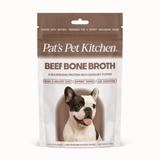
Bone broth: Beef Bone Broth contains gelatin (partially hydrolysed collagen) plus minerals that support gut integrity.
Probiotics: Consider adding a dog probiotic to support gut microbiome.
The Timeline: What to Expect with Supplementation
If you start collagen supplementation:
Week 1-2: No noticeable changes. Collagen is accumulating in tissues.
Week 2-4: Skin and coat improve first. Shinier coat, less itching, improved skin elasticity.
Week 4-6: Joint improvements become noticeable. Less stiffness, easier movement, more enthusiasm.
Week 8-12: Maximum benefit. Sustained improvement in mobility, coat quality, overall vitality.
Long-term (6+ months): Continued benefits as long as supplementation continues. Slows age-related decline.
Important: Benefits only last while you supplement. Stop supplementation = collagen levels drop again within weeks.
The Difference Between Breeds
Small breeds (under 10kg):
-
Live longer (12-16+ years)
-
Collagen decline is slower but lasts longer
-
Often show skin/coat changes before joint issues
Medium breeds (10-20kg):
-
Average lifespan (10-14 years)
-
Balanced collagen decline
-
Joint and skin issues appear around same time
Large breeds (20-30kg):
-
Shorter lifespan (8-12 years)
-
Faster collagen decline
-
Joint issues appear earlier (age 5-7)
X-Largebreeds (30kg+):
-
Shortest lifespan (6-10 years)
-
Rapid collagen decline
-
Joint issues often present by age 4-5
The larger the dog, the earlier you need to start preventative supplementation.
Can You Restore Lost Collagen?
Honest answer: You cannot reverse decades of collagen loss.
But you CAN:
-
Slow further decline dramatically
-
Restore partial function to weakened tissues
-
Help slow age-related changes
-
Significantly improve quality of life
Think of it like this:
If your dog is 10 years old and has been in collagen deficit for 5 years, supplementation won't make them 5 again.
But it will:
-
Stop them getting worse
-
Improve comfort and mobility
-
Add good quality years to their life
-
Slow the aging process going forward
Collagen supplementation is used to support:
-
Joint mobility
-
Skin elasticity
-
Coat quality
-
Energy levels
-
Overall quality of life
It works. It just doesn't turn back time completely.
The Collagen Deficit
Think about a 10-year-old Labrador.
From middle age onwards, production gradually falls behind breakdown. In any single year the shortfall is small. Over several years, it adds up.
Can you replace it all with supplements?
No. Supplementation cannot make up for years of accumulated deficit.
But you can:
-
Provide building blocks to slow further loss
-
Stimulate remaining production capacity
-
Support repair of existing tissue
It's not about replacing everything. It's about stopping the decline.
The Science is Clear
Collagen production declines with age. This is inevitable.
The decline causes:
-
Joint problems
-
Skin aging
-
Reduced wound healing
-
Weakened gut lining
-
Brittle bones
-
Overall loss of vitality
But the decline can be slowed:
-
Hydrolysed collagen supplementation (supplies the building blocks)
-
Vitamin C sufficiency (essential cofactor)
-
Omega-3 fatty acids (reduce breakdown)
-
Weight management (reduce mechanical stress)
-
High-quality nutrition (provide building blocks)
Start supplementation at age 5-6 (before symptoms appear).
Prevention is far more effective than treatment.
Take Action Today
If your dog is:
Under 5 years (from 6 months of age): Start Pure Collagen now for prevention. Build reserves before decline begins.
5-8 years (showing early signs): Use Mobility & Joints for comprehensive support.
8+ years (senior): Use Mobility & Joints + omega-3 supplement for maximum support.
Picky eater at any age: Try Beef Bone Broth mixed with water.
You can't stop time. But you can slow its effects.
Last Updated: August 2026