Your dog is slowing down.
The enthusiastic puppy who bounced everywhere is now hesitating at stairs. They're stiff after rest. They've stopped jumping on the sofa.
This isn't "just getting old." It's their joints breaking down faster than their body can repair them.
Here's how to keep your senior dog comfortable, active, and pain-free for years longer.
What Counts as a Senior Dog?
By size:
-
Small breeds (under 10kg): Senior at 10-12 years
-
Medium breeds (10-25kg): Senior at 8-10 years
-
Large breeds (25-40kg): Senior at 6-8 years
-
Giant breeds (40kg+): Senior at 5-7 years
Large and giant breeds age faster because their joints carry more weight throughout their lives. A 7-year-old Great Dane is equivalent to a 10-year-old Cocker Spaniel in joint health terms.
The 7 Signs Your Senior Dog Has Joint Issues
Most owners miss the early signs. Dogs are stoic. They hide pain instinctively.
Watch for:
1. Stiffness after rest: They struggle to stand after lying down. First few steps are slow, then they "warm up" and move better.
2. Hesitation at stairs: They pause at the bottom, calculating whether it's worth the effort. Some stop using stairs entirely.
3. Reduced playtime: They're not chasing balls like they used to. Play sessions are shorter. They choose lying down over activity.
4. Difficulty getting up: Takes multiple attempts to stand. They might rock back and forth before getting their legs under them.
5. Limping or favouring one leg: Intermittent limping that comes and goes. Worse in cold or damp weather.
6. Reduced jumping: They used to leap onto the sofa or into the car. Now they need help or avoid it entirely.
7. Behavioural changes: Irritability when touched in certain areas. Less social. Sleeping more.
If your dog shows 2 or more of these signs, their joints need support.
What's Happening in Your Senior Dog's Joints
The natural process:
As dogs age, cartilage (the cushioning material in joints) breaks down faster than the body can rebuild it.
Why this happens:
-
Collagen production naturally slows as dogs get older
-
Synovial fluid (joint lubrication) decreases
-
Inflammation increases
-
Cartilage cells become less efficient at repair
The result: Bone rubs on bone. Movement becomes painful. Your dog compensates by moving less, which weakens muscles, which puts more stress on joints. It's a downward spiral.
Studies show: 80% of dogs over 8 years old have radiographic evidence of osteoarthritis, even if they're not showing symptoms yet.
The 5 Pillars of Senior Dog Joint Care
1. Weight Management (Most Important)
Every extra kilogram your dog carries adds load to joints that are already working hard.
If your senior dog is overweight, nothing else matters as much as getting them to a healthy weight.
How to tell if they're overweight:
-
Can't feel ribs easily when running hands along sides
-
No visible waist when viewed from above
-
Belly sags or waddles when walking
Target: You should feel ribs with light pressure, see a waist, and see a tuck-up behind ribs when viewed from the side.
Weight loss strategy for senior dogs:
-
Reduce food by 10-15% (not drastically, just slightly less)
-
Switch to lower-calorie food if needed
-
Increase gentle activity (more walks, even if slower)
-
No table scraps or high-calorie treats
2. Appropriate Exercise
The rule: Little and often.
Good for senior dogs:
-
Short walks (15-20 minutes) 2-3 times daily
-
Swimming or hydrotherapy (zero impact on joints)
-
Gentle play at their pace
-
Slow-paced sniffy walks (let them set the speed)
Bad for senior dogs:
-
Long hikes (over 30 minutes puts too much stress on joints)
-
Running alongside bikes
-
Jumping for balls or frisbees
-
Playing with young, energetic dogs (they'll overdo it)
The goal: Keep muscles strong (supports joints) without overdoing it and causing inflammation.
Winter tip: Senior dogs are more affected by cold and damp. Shorter walks in winter, consider a dog coat for warmth.
3. Joint Supplements
This is where most owners see the biggest improvement.
What works:
Collagen peptides, served by your dog's bodyweight:
-
Pat's Pet Kitchen's guide runs 1 teaspoon (3g) for a dog of 1 to 10kg, 2 teaspoons (6g) for 11 to 20kg, 3 teaspoons (9g) for 21 to 30kg, and 4 teaspoons (12g) from 31kg upwards
-
Weigh your dog and use the band they fall into, rather than working to a single fixed number
-
Provides building blocks for cartilage repair
-
Studies show significant improvement in mobility after 8-12 weeks
-
Types I and III collagen support entire joint structure (cartilage, tendons, ligaments)
Our recommendation: Pure Collagen for foundational support (100% hydrolysed collagen peptides, so a 2 teaspoon (6g) serving for an 11 to 20kg dog gives 6,000mg of collagen) or Mobility & Joints for dogs with existing issues (combines collagen with glucosamine and hyaluronic acid).
Glucosamine:
-
Supports cartilage integrity
-
Reduces inflammation
-
Most effective when combined with collagen
Hyaluronic acid:
-
Lubricates joints (acts like WD-40)
-
Reduces friction during movement
-
A supporting ingredient rather than a standalone fix. It does its job inside a complete formula, working alongside collagen and glucosamine
Omega-3 fatty acids (EPA/DHA from fish oil):
-
Powerful anti-inflammatory
-
Feed according to the guidance on the product you choose, or ask your vet what suits your dog's size
-
Look for high EPA content specifically
What to avoid:
-
Unhydrolysed collagen (your dog can't absorb it)
-
Chews with fillers and additives
-
Brands that won't tell you what a serving contains, or won't give you a serving guide by bodyweight
Timeline: Most owners see improvements around week 4-6 with daily supplementation. This isn't a quick fix. You're rebuilding tissue.
4. Pain Management
When supplements aren't enough:
Some senior dogs need prescription pain medication. This is OK. Quality of life matters.
Common veterinary options:
-
NSAIDs (non-steroidal anti-inflammatories): Metacam, Rimadyl, Previcox
-
Gabapentin (nerve pain)
-
Tramadol (moderate to severe pain)
-
Amantadine (chronic pain)
Important: Never give human painkillers. Paracetamol and ibuprofen are toxic to dogs.
Work with your vet to find the right balance. Many dogs do well on a combination of supplements + low-dose medication.
Natural pain relief:
-
Cold therapy (ice packs) for acute flare-ups (10 minutes at a time)
-
Heat therapy (warm towels) for chronic stiffness (15 minutes)
-
Massage (gentle circular motions around joints)
5. Home Modifications
Make your home easier to navigate.
Simple changes that help:
-
Ramps for getting in car or onto sofa (if they still want to)
-
Non-slip mats on hard floors (slipping is painful and scary for arthritic dogs)
-
Raised food and water bowls (less strain on neck and shoulders)
-
Orthopaedic bed with memory foam (supports joints during sleep)
-
Night lights (senior dogs often have declining vision too)
-
Baby gates at top of stairs (prevent falls)
Cost: You don't need expensive equipment. A few non-slip yoga mats strategically placed cost £20 and make a huge difference.
What About Surgery?
For severe cases, surgery might be an option.
Common procedures:
-
Total hip replacement: £5,000-8,000
-
Cruciate ligament repair: £2,000-4,000
-
Arthroscopy: £1,500-3,000
When to consider surgery:
-
Severe pain that doesn't respond to medication
-
Complete loss of function in a limb
-
Young dog (under 8) with traumatic injury
-
Quality of life is severely impacted
Deciding whether surgery is right for your dog:
This one is for your vet. They will weigh your dog's age, general health, any other conditions, and how well they are responding to supplements and medication. Ask about a referral to a veterinary orthopaedic specialist if you want a second opinion before deciding.
Recovery: 8-12 weeks minimum. Requires dedicated rehabilitation. Not suitable for all dogs.
Alternative Therapies That Actually Work
Hydrotherapy:
-
Underwater treadmill or swimming
-
Builds muscle without joint stress
-
Many dogs show improvement after 6-8 sessions
-
Cost: £30-50 per session
Find a hydrotherapist: Canine Hydrotherapy Association
Physiotherapy:
-
Stretching, massage, joint mobilisation
-
Teaches you exercises to do at home
-
Cost: £40-60 per session
Find a physiotherapist: Association of Chartered Physiotherapists in Animal Therapy
Acupuncture:
-
Some dogs respond well for pain relief
-
Not scientifically proven but anecdotally helpful
-
Cost: £40-70 per session
Laser therapy:
-
Reduces inflammation
-
Available at some vet practices
-
Cost: £30-50 per session
What doesn't work:
-
Magnetic collars (no scientific evidence)
-
Copper bowls (placebo at best)
-
Homeopathy (ineffective for joint pain)
The Complete Senior Dog Joint Care Protocol
Daily:
-
Joint supplement (collagen + glucosamine) with breakfast, at the serving for your dog's weight band
-
Omega-3 fish oil with dinner
-
2-3 short walks (15-20 minutes each)
-
Gentle stretching or massage (5 minutes)
Weekly:
-
Weight check (adjust food if gaining)
-
Nail trim (long nails affect gait)
-
Mobility assessment (are they getting better or worse?)
Monthly:
-
Vet check-up if on medication
-
Review and adjust exercise routine
-
Check bedding and home setup
Every 3 months:
-
Full vet examination
-
Blood work if on NSAIDs
-
Reassess supplement protocol, including whether their weight has moved them into a different serving band
Which Supplement Should You Choose?
For prevention (mild stiffness, still active): Pure Collagen - 100% hydrolysed collagen peptides, served by weight, so the 2 teaspoon (6g) serving for an 11 to 20kg dog gives 6,000mg of collagen. Supports joints, skin, gut, and bones. Tasteless and odourless.
For existing joint issues (moderate stiffness, reduced mobility): Mobility & Joints - Advanced 6-in-1 formula with collagen, glucosamine, hyaluronic acid, and vitamins C & E. Targets joint comfort from multiple angles.
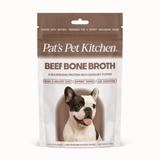
For picky eaters or dogs who need gut support too: Beef Bone Broth - 40% collagen content plus natural gelatin. Creates an irresistible gravy that even fussy dogs will eat.
Not sure? Choose one. Pure Collagen if your dog is still active with mild stiffness, Mobility & Joints if stiffness is already affecting how they move. There's no need to run both, and if you think your dog needs more than one product, ask your vet first.
When to See Your Vet
See your vet if:
-
Sudden severe lameness (can't bear weight)
-
Swelling around joints
-
Yelping or crying when moving
-
Complete refusal to use a limb
-
Behavioural changes (aggression when touched)
-
Not responding to supplements after 8 weeks
Don't wait. Joint problems are progressive. Earlier intervention = better outcomes.
What Results to Expect
With consistent joint care (supplements + exercise + weight management):
Week 2-4:
-
Slight improvement in stiffness
-
Better mood and energy
Week 4-8:
-
Noticeable improvement in mobility
-
Easier getting up and down
-
More enthusiasm for walks
Week 8-12:
-
Sustained improvement
-
Playing more
-
Acting "younger"
Long-term (6+ months):
-
Slower progression of arthritis
-
Maintained quality of life
-
Better muscle tone
-
Reduced need for pain medication
The Biggest Mistakes Owners Make
1. Waiting too long: By the time you see obvious symptoms, cartilage damage is already significant. Start preventative care at age 7 for large breeds, age 9 for small breeds.
2. Stopping supplements when improvement happens: Joint supplements are maintenance, not a cure. If you stop, symptoms return within weeks.
3. Letting them get overweight: "He's a good eater" isn't an excuse. Obesity is the single biggest controllable factor in joint pain.
4. Over-exercising on good days: Your dog will push through pain on a sunny day. You need to manage their activity, not let them dictate it.
5. Using only pain medication without supplements: Pain meds mask symptoms. Supplements actually support joint repair. You need both.
6. Guessing the amount: Giving a scoop "about right" for a dog you haven't weighed is how dogs end up under or over served. Weigh them, then use the band on the pouch.
7. Giving up too soon: If one supplement doesn't work after 4 weeks, try a different one. Dogs respond differently.
Your Senior Dog's Best Years Are Still Ahead
Joint problems don't mean your dog's active life is over.
With the right care, most senior dogs can remain comfortable, mobile, and happy well into their teens.
Start today:
-
Assess their current mobility (use the 7 signs checklist)
-
Weigh your dog so you know which serving band they fall into
-
Start a joint supplement and give it consistently
-
Adjust exercise to shorter, more frequent walks
-
Make home modifications
-
Book a vet check-up if you haven't in 6 months
Your dog gave you their best years. Now it's time to give them theirs.
Sources & Further Reading
-
British Veterinary Association - Senior Pet Care Guidelines: https://www.bva.co.uk/
-
Canine Arthritis Management: https://caninearthritis.co.uk/
-
Johnston SA. "Osteoarthritis: Joint anatomy, physiology, and pathobiology." Veterinary Clinics of North America, 1997
-
Marshall WG, et al. "The effect of weight loss on lameness in obese dogs with osteoarthritis." Veterinary Research Communications, 2010
-
Bello AE, Oesser S. "Collagen hydrolysate for the treatment of osteoarthritis." Current Medical Research and Opinion, 2006
-
RCVS Knowledge - Pain Management Guidelines: https://knowledge.rcvs.org.uk/
-
British Veterinary Orthopaedic Association: https://www.bvoa.org.uk/
-
Canine Hydrotherapy Association: https://www.canine-hydrotherapy.org/
-
Association of Chartered Physiotherapists in Animal Therapy: https://www.acpat.org/
-
Oesser S, Seifert J. "Stimulation of type II collagen biosynthesis." Osteoarthritis and Cartilage, 2003
Last Updated: August 2026